
Raymarine fish finders: sonar, mapping and product families
Original publication: 2020-11-17.
Original image credits are retained. Image-use permission was confirmed by the site owner.
Raymarine has for some time firmly in the market for depth finders and fish finders established. With the introduction of the ultra-modern Axiom series and its successor models, the manufacturer has become extremely interesting for the recreational skipper and the fishing community. In this article, we want to take a closer look at what makes its fish finders so particularly attractive for fishing.
Table of Contents
- A little about the history and development of Raymarine
- What are the advantages of Raymarine as a sonar brand?
- What are the strengths of the Raymarine fish finders?
- Which chart plotter and fish finder series are currently offered by Raymarine?
- Overall conclusion Raymarine fish finders
1. A little about the company's history and development
Raymarine is a leading manufacturer of electronics for the recreational and light commercial sectors. Although it has been on the market for around 80 years, most of its eventful history has been part of the American Raytheon group. The Raymarine brand name has only existed as a standalone since 2001. After the turmoil during the 2007-2008 financial crisis, the brand is now part of the American FLIR group, which (like Raytheon) primarily develops and manufactures products - such as camera systems - for the defense industry.
The first volume models (E-, C- and A-series) of the manufacturer were not represented so numerous in the fishing sector. That changed suddenly when Raymarine mixed up the market with the Dragonfly models. These devices were something special because they gave the angler a tool that made the latest multi-frequency technology (chirp) affordable. The fish finder images were already extremely good in comparison to the introductory times. In addition, the user hardly needed to adjust anything in order to achieve optimal results.
At the same time as the Dragonflies, Raymarine continued to use the aforementioned E to A series, which initially did not sell in large numbers to sport fishermen - one of the main factors was certainly the price. That has changed fundamentally in the last few years. Since the introduction of the state-of-the-art Axiom models and the downsized Element series, Raymarine fish finders and combi devices have become a fixed and extremely interesting item in the sport fishing sector.
2. What are the advantages of Raymarine as a sonar brand?
In the following we have summarized the features and USPs of Raymarine among the sonar device manufacturers in a clear list :
- With Raymarine Germany in Hamburg, the European service center in the UK and a well-structured network of service points, dealers and experts, Raymarine customers can feel well looked after. Almost every larger sport boat harbor is serviced by the manufacturer.
- With the exception of the Dragonfly models with a 1-year guarantee, all others have a 2 -year guarantee. This can be extended to three years free of charge with a simple registration.
- Raymarine fish finders are timeless in design, comfortable to use, well equipped in terms of hardware, and experience has shown that they are durable and robust in practical use.
- Raymarine devices come with innovative software (operating system) and, as a rule, four echo sounding methods including 3D (no accessories required). In a direct comparison, this is definitely a unique selling point.
- However, Raymarine has only recently started serving the sport fishing sector. Other manufacturers such as Lowrance, Humminbird or Garmin had a stronger preference for this. As already mentioned, Raymarine comes from the defense industry.
3. What are the strengths of the Raymarine fish finders?
Back to the table of contentsIn the following chapters we want to take a closer look at the hardware and software equipment of the manufacturer. Their strengths - as well as possible weaknesses - will be examined in more detail to see in which areas they differ from other echo sounder manufacturers.
3.1. What hardware do we find in Raymarine devices?
First of all, you have to attest that the manufacturer is generally not stingy when it comes to component selection. The screens used are already a real highlight in the Dragonfly entry-level models - and especially in the higher-quality model lines. The IPS LCDs of the new Axiom + and Pro series are excellent.
What is an IPS display?
IPS is the abbreviation for "In-Plane Switching" and describes a special screen technology for LCD displays. It refers to the alignment of the liquid crystals, which has particular physical advantages. First of all, the following should be mentioned
- the improved viewing angle stability up to 180 °
- as well as the intensified color rendering.
- An IPS display also stands out from a normal TN type with a wide color space,
- Overall improved image properties (e.g. sharpness of detail)
- and high contrast.
For you as an angler this has only advantages. You
- always see well on your screen regardless of your location (large viewing angle),
- reliably detect even the smallest objects and
- can easily read the screen information even when the sun is shining.
Another example of the excellent component selection in Raymarine devices is the use of quad-core processors from the inexpensive Element series. You have to take the top products of the competition to get such technical data.
What is a quad core processor?
Quad-core CPUs are used to increase the clock rate in computing processes, i.e. to increase the operating speed. With this type of CPU , the tasks are distributed over several cores working in parallel so that the CPU does not reach its limits even in intensive work processes. In practice, a significant increase in performance compared to single or dual-core models is achieved. Delays in setting up screens e.g. in map displays or computationally intensive echo sounding methods such as a 3D display (RealVision 3D) are avoided. Raymarine repeatedly showed in our practical tests that the Element series is already very fast in this respect.
3.2. What echo sounding methods does Raymarine use?
The four echo sounding methods of the Raymarine devices from the Element series are almost a unique selling point.
- In addition to chirp in the 2D area
- Down and SideScan is offered
- as well as the integrated 3D technology RealVision 3D.
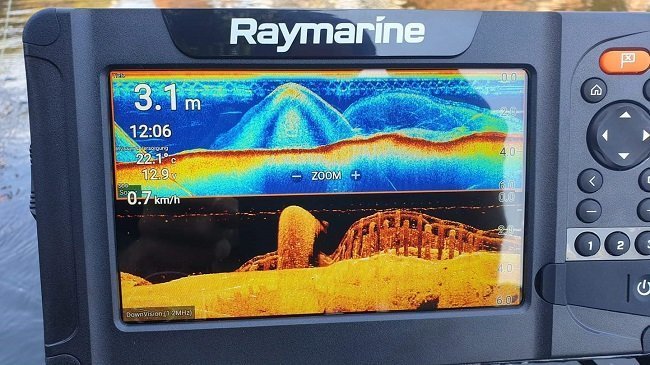
This is unique in this combination - especially since the appropriate transducers can implement all four scanning processes. The Element series also includes HyperVision. This is a pulse method with high frequencies (1200 kHz). HyperVision and Realvision may require further explanation for one or the other.
What is HyperVision?
Sonar transducers send their impulses (pings) with different frequencies that have different characteristics.
- Low frequencies such as 50 kHz have a long depth range, but capture small objects poorly or not at all.
- High frequencies such as 800 kHz cause exactly the opposite. They resolve the picture far better. The result is sharper, more differentiated and more detailed fish finder images. Unfortunately, this comes at the expense of the depth range.
HyperVison is nothing more than a pulse process in the high frequency range - in this case with 1200 kHz. This is used in Raymarine Element HV models in Side-, Down- and RealVision 3D. This leads to image results that can finally be called photo-realistic.
What is RealVision 3D?
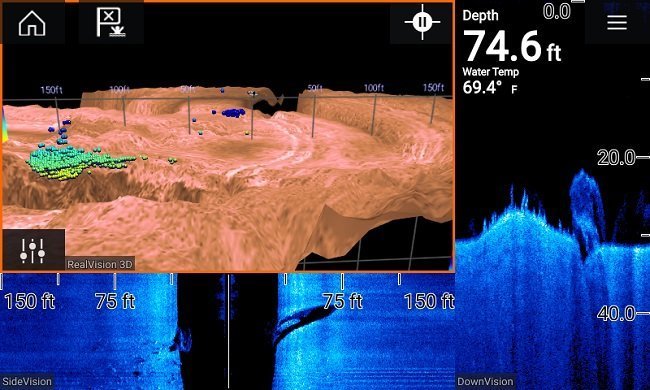
RealVision 3D is a 3D sonar technology that is available in all Raymarine combination devices starting with the Element HV series. It is the number 4 Raymarine sonar technology along with the three other methods 2D Chirp, Down- and SideVision. This sonar package with a single quadruple transducer without any other additional hardware is currently unique on the fish finder market. The RealVision Sonar 3D is a three-dimensional representation of the underwater conditions around the boat (back, right and left). Shown are
- all structures,
- soil conditions,
- fish,
- bait
- and other objects in an incredible density of information.
The user can tilt, zoom, and pan the 3D image and thus change the viewing angle as desired. The reference point is always your own boat, so that every fish as well as every other object can be precisely located. The angler can therefore not only see where the fish is in relation to his boat location - he also knows at what depth it is above ground.
3.3. What does Raymarine focus on in terms of operating system and ease of use?
All Raymarine devices are easy to use and have a lot of automation in the area of adjustment and optimization. Of course, that suits the user. While the Raymarine Element HV series is controlled via a keyboard and comes with Lighthouse Sport, a compact operating system designed for sport fishing, the Axiom models shine with a full glass front with touchscreen operation. The Axiom Pro models are an exception, as they also have a keypad. This has advantages for use in choppy weather. The SD card slots come back together with the keypad in the front area. The Axiom Plus and Axiom models are known to have the card slot inconveniently located on the back. All Axiom devices are also equipped with the excellent Lighthouse 3 operating system. This is
- fast in the processes,
- easy to use
- and intuitively understandable.
Distinctive app symbols also characterize the start page, which can be individually adapted to personal preferences.
3.4. What about GPS and navigation at Raymarine?
Chartplotter, GPS and navigation are flexible in the use of the selected sea charts (Navionics, C-Map 4D, Lighthouse) with the Raymarine models. Live mapping systems have recently become available with SonarChart Live and RealBathy. All Axiom models meet higher quality requirements for GPS and plotters, the entry-level versions Dragonfly and Element are not quite as good here (e.g. in terms of GPS sensitivity).
What is SonarChart Live?
SonarChart Live is the latest mapping option from Navionics, which can be used on practically all sonar devices (except Garmin) on the market - including Raymarine. While the boat is moving, you can watch as new fishing charts with depth contours are automatically created and superimposed on the existing nautical chart. The prerequisite is that a Navionics sea chart must first be available on the plotter. Then virgin waters can also be charted according to the same pattern.
What is RealBathy?
Raymarine has integrated its own mapping method - RealBathy - in the 3.9 Lighthouse update. This enables bathymetric maps with depth contours (fishing charts) to be created quickly in real time. The generator uses the GPS in connection with the sonar device connected to it in order to obtain the required information. The big advantage of RealBathy: There is no need to buy or subscribe to maps beforehand.
- You just put the boat in the water,
- insert an SD card with sufficient memory, and
- start the map creation via the operating system.
4. Which chart plotter and fish finder series are currently offered by Raymarine?
Note: Raymarine offers so-called multifunction displays with the Axiom series. This means,
on the one hand there are pure plotter models
as well as those that have also integrated sonar functions.
In the following we will deal exclusively with the combination devices - i.e. those with a built-in sonar. They can be recognized by the addition "RV". An Axiom 7 RV is one such device, an Axiom 7 just one with GPS and plotter function.
The entry-level range with the Dragonfly PRO series with two devices in 5 and 7 inches. It was already put on the discontinued list years ago, but was then left in the program after a thorough revision. In our opinion, this is a good decision for everyone who wants high performance with few frills.
In the medium price range, the manufacturer has established the Raymarine Element series, which was created in 2018 in downsizing from the Axiom series set a short time before. This series of devices is tailored to the needs of the angler (e.g. with regard to the operating system). Although somewhat reduced in terms of equipment and comfort, but echotechnically left at the excellent Axiom standard. And beyond that, even expanded with HyperVision. Please note: The Element series also has pure GPS / plotter models without the addition of "HV".
The Axiom family has continued to grow. It now consists of four device lines that have more or less evolved from the revision and model upgrates of the original series. In the overview below, we present the revised Axiom Plus and Axiom Pro series , which best describe the possibilities of these model lines. We also address the differences between Axiom + and Axiom. Finally, we will also briefly examine the demands of the new Axiom XL series.
The Raymarine fish finder series at a glance
In the following we offer you a detailed overview of the current Raymarine fish finders, so that you can get an impression of the equipment, technology and performance of each model. This should help you find the right depth finder for you or make a meaningful comparison with the fish finders of other manufacturers. In some cases you will also find a practical test for the individual devices. Corresponding links are placed in the appropriate places in the text.
4.1. The Dragonfly Pro series
Back to the table of contents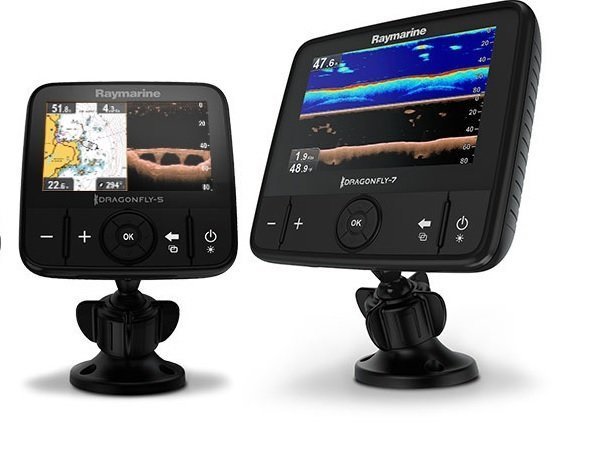
The Dragonfly models have only ever been available up to a 7-inch screen size. Two types with 5 and 7 inches are currently available. These scan with 2-channel Chirp conventionally in 2D and in Chirp DownScan, so that currently both sonar methods are running permanently. This has the advantage that all information such as fish sighting and bottom structure course are available in parallel. Raymarine has also significantly improved the range in the course of the model update, so that regions over 200 m depth (e.g. in Norway) can be reliably recorded.
The Dragonfly models are simple and straightforward to use. The technology produces very good, sharp and crisp images - and those who like it can also delight their mobile phone or tablet with the scan results via the WLAN interface. The Dragonfly Pro devices are currently also compatible with the Navionics Boating app and can also create your own nautical charts with SonarChart Live. An interesting package - not just for beginners.
The overview of the Raymarine Dragonfly models:
| Features and functions | Dragonfly 5 Pro | Dragonfly 7 Pro |
|---|---|---|
| Screen resolution | 800/480 | 800/480 |
| Screen size in inches | 5 | 7 |
| GPS | X | X |
| SD card slot | X | X |
| Chartplotter | X | X |
| Boating-App compatible | X | X |
| C-Map and Navionics Charts | X | X |
| SonarCharts Live compatible | X | X |
| Android and iOS compatible | X | X |
| DownScan Chirp | X | X |
| SideScan | - | - |
| 2D Chirp | X | X |
| Dragonfly transducer* | X | X |
| Depth range DownScan / 2D | 180 / 275 m | 180 / 275 m |
| Transmitting power RMS | N/A | N/A |
| Newtwork capability | - | - |
| Keyboard operation | X | X |
| Touchscreen | - | - |
| Surface- / flush-mounting | x/- | x/- |
| Price incl. transducer about | 380 €* | 480 €* |
Conclusion: Even if the SideScan options are missing, the Dragonflys are fully equipped with everything you need for sonar fishing. Thanks to the joint mount, they can be used almost anywhere and with their compact dimensions they are the first choice for belly boats or fishing kayaks. There is nothing to complain about in terms of performance and scan results. The price-performance ratio is good and with the Android and iOS compatibility , the manufacturer has taken an important step in the right direction.
Another tip for mobile use: The Dragonflys fit wonderfully in the compact fish finder pocket from Garmin. They are perfectly stored there without changing the attachment options - all you have to do is install a self-tapping screw for two of the threaded screws.
Read here:
- Raymarine Dragonfly 4 and 5 Pro review: which is the best mid-range fish finder?
4.2. The Raymarine Element HV Series
Back to the table of contents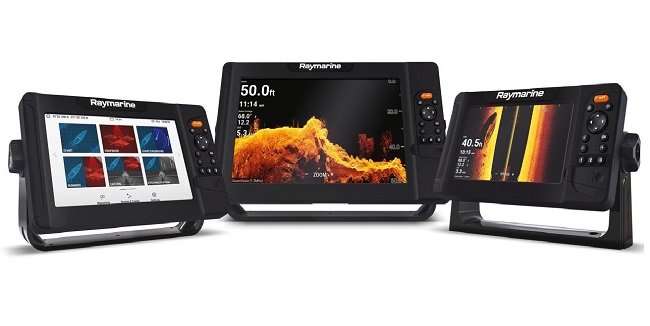
“The Raymarine Element HV series is awesome”. This is what a specialist dealer once put it in 2019 - and he wasn't just referring to the huge sales of the series of devices among sport fishermen (and not only among them).
Let's start with the fish finder, that
- in addition to the usual trio ( 2D Chirp, Side- and DownScan )
- also offers Real Vision 3D and
- with Hypervision (1.2 MHz), in addition to the 350 kHz standard setting in all three fish finder technologies, including 3D, a high-resolution display level is added.
The result: Underwater structures, vegetation and also fish are brought out realistically. This is unique in this price range. And the price makes the package really good. The Element 7 HV with the All-In-One HV-100 transducer is currently on the shelves at a dealer discount price of around € 650.00. Hard to believe, but true!
So: Where was savings made to make this possible? The hardware with a quad-core processor and the excellent screen do not give any indication of savings potential. The missing touchscreen operation, the narrow-chested operating system (Sport) and the plotter with less powerful GPS fit into the picture. But, let's be honest - with the overall package there are no real compromises that you have to accept here.
The overview of the Raymarine Element HV models:
| Featuresand functions | Element 7 HV | Element 9 HV | Element 12 HV |
|---|---|---|---|
| Screen resolution | 800/480 | 800/480 | 1280/800 |
| Screen size in inches | 7 | 9 | 12 |
| GPS | 10 Hz | 10 Hz | 10 Hz |
| SD card slot | X | X | X |
| Chartplotter | X | X | X |
| SonarCharts Live | X | X | X |
| RealBathy mapping | x | x | x |
| C-Map, Navionics Charts | X | X | X |
| Quad-core processor | X | X | X |
| 2D-Chirp | X | X | X |
| DownVision (350 + 1200 kHz) | X | X | X |
| SideVision (350 + 1200 kHz) | X | X | X |
| RealVision 3D (350 / 1200 kHz) | X | X | X |
| All-In-One transducer HV-100* | X | X | X |
| Depth range 2D / 350 / 1200 | 275 / 180 / 30 m | 275 / 180 / 30 m | 275 / 180 / 30 m |
| Keyboard operation | X | X | X |
| Touchscreen | - | - | - |
| WLAN | X | X | X |
| Bluetooth | X | X | X |
| Smartphone integration | - | - | - |
| Transmitting power RMS | N/A | N/A | N/A |
| Network capability NMEA 2000 | X | X | X |
| Quick access function keys | 3 | 3 | 3 |
| Surface- / flush-mounting | x/x | x/x | x/x |
| Price incl. transducer about | 650 €* | 1050 €* | 1395 €* |
Conclusion: In our individual test of the Element 7 HV with the HV-100 All-In-One transducer, we put the test result in a nutshell as follows: “The Raymarine Element 7 HV has everything you can expect from a sonar device - and that in astonishingly good quality at an instantly unrivaled price ”. You don't have to add anything more, but you can put it into perspective for the larger models in terms of price.
Read here:
- Raymarine Element 7 HV review: Full 3D display at a bargain price?
4.3. The Raymarine Axiom Plus Series
Back to the table of contents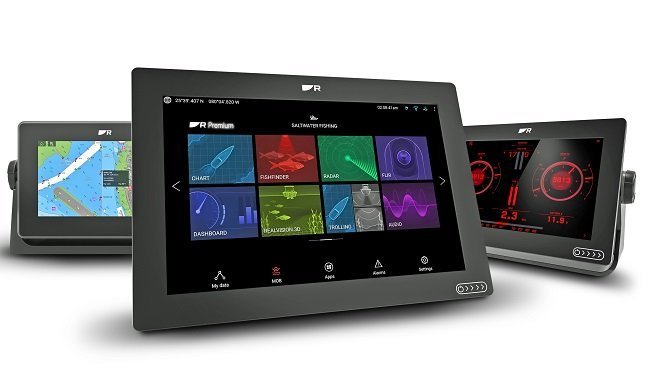
Raymarine introduced the Axiom multifunctional displays in 2017 and attracted attention with the generation change in the portfolio.
- With an elegant design ,
- full glass display without control buttons,
- four built-in sonar techniques and
- the Lighthouse operating system,
the device series sets itself apart from the market average. The current Axiom Plus series has undergone a revision of the display, GPS module and working memory in 2020. Otherwise, it is identical to the previous Axiom models in terms of technology and features.
A powerful quad-core processor with 16 GB of internal memory forms the basis for the versatile plotter and the brilliant sonar. Realvision 3D and three other echo sounding methods (2D Chirp, Down- and SideVision) map an extensive scan spectrum, which will delight every angler's heart in this abundance and display quality. In addition, the integration of the complete sonar package in a single transducer should be emphasized, which makes an additional hardware expansion unnecessary.
What does "gyrostabilized" mean?
Among other things, the three-dimensional scanning (RealVision) in the Axiom series is gyrostabilized, i.e. the electronics compensate for ship movements. Otherwise, the echo would lose the bottom more often in the sensitive 3D process, as was seen, for example, in our field test of the Element 7 HV.
Of course, the Raymarine Axiom series is fully network compatible. A wide range of marine accessories is supported. With WiFi, Bluetooth and the Raymarine app , tablets and smartphones can also be used to display the sonar and plotter. What remains is a small downer for the full glass front. The SD card slots are on the back of the device. This makes an external card reader necessary when installing. At least this is available in the Raymarine accessories.
If you are now faced with the question of buying a device from the Axiom or rather the Axiom Plus series, we recommend that you take a close look at the differences. After all, the screen on Axiom + has
- a better resolution,
- more brightness,
- a wide viewing angle and
- greater color depth through the use of state-of-the-art IPS LCDs.
- The new HydroTouch coating also allows the water to run off better and thus repels dirt, oil, etc.
You can also look forward to a highly sensitive GPS and a memory upgrade, which will set you up for future expansions.
The overview of the Raymarine Axiom Plus RV models:
| Features and functions | Axiom-Plus 7 RV | Axiom-Plus 9 RV | Axiom-Plus 12 RV |
|---|---|---|---|
| Screen resolution | 1024/600 | 1280/720 | 1280/800 |
| Screen size in inches | 7 | 9 | 12 |
| IPS-Display HydroTouch | X | X | X |
| GPS | 10 Hz | 10 Hz | 10 Hz |
| Lighthouse-3 operating system | X | X | X |
| SD card slot rear | 2 | 2 | 2 |
| Charplotter | X | X | X |
| SonarCharts Live | X | X | X |
| RealBathy mapping | x | x | x |
| C-Map, Navionics Charts, etc. | X | X | X |
| Quad-core processor | X | X | X |
| Internal memory > 16 GB | X | X | X |
| 2D Chirp | X | X | X |
| DownVision | X | X | X |
| SideVision | X | X | X |
| RealVision 3D | X | X | X |
| HyperVision 1200 kHz | - | - | - |
| All-In-One transducer RV-100* | X | X | X |
| Other transducers possible | 5 | 5 | 5 |
| Depth range 2D / 455 kHz | 275 / 180 / 90 m | 275 / 180 / 30 m | 275 / 180 / 30 m |
| Keyboard operation | - | - | - |
| Full glass front without knobs | X | X | X |
| Touchscreen | X | X | X |
| WLAN | X | X | X |
| Bluetooth | X | X | X |
| Smartphone integration | - | - | - |
| Transmitting power RMS | 600 W | 600 W | 600 W |
| Network capability NMEA | X | X | X |
| Marine network LAN | X | X | X |
| Quick access function keys | - | - | - |
| Surface- / flush-mounting | x/x | x/x | x/x |
| Price incl. transducer about | 1300 €* | 1700 €* | 3000 €* |
Conclusion: The Raymarine Axiom or Axiom Plus series is a real buy recommendation for us in the fish finder upper class. With high component quality, very good equipment, a great sonar ensemble (without HyperVision), we also like the modern design and the fast, easy-to-use Lighthouse 3 operating system. In the marine network and in the flexibility of navigation and plotter use, the Axiom + meets high expectations. With prices of about € 1300 for an Axiom Plus 7 RV and € 1700 for the 9-inch version (each with a quadruple transducer RV-100), you get an excellent value.
4.4. The Raymarine Axiom Pro RV Series
Back to the table of contents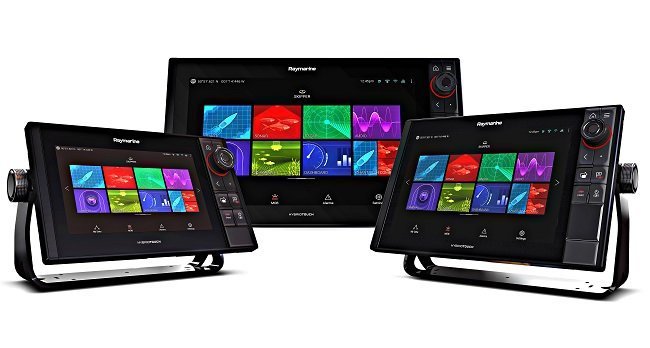
Those looking into the Axiom Professional series will ask themselves, given the significantly higher prices, "What can this do more than the manufacturer's Axiom Plus series?" The front view of an Axiom Pro provides the first clue here. One can be operated with a touchscreen as well as with a keypad plus rotary dial. This brings advantages in higher sea states. The card slots have also been moved to the front along with the control panel. This is much more convenient in handling.
Equally pleasing: The hardware upgrades. In addition to a fast quad-core CPU, a large RAM and an echo sounder module with 1 KW transmitting power as well as extensive transducer compatibility also shine from the Airmar shelf. Ocean operations are thus just as possible as operations in shallow water. Safety on board is further ensured by an optional connected thermal imaging camera in conjunction with the ClearCruise function of the device, which can automatically detect dangerous areas in the course of the ship.
The overview of Raymarine Axiom Pro RV models:
| Features and functions | Axiom Pro 9 RV | Axiom Pro 12,1 RV | Axiom Pro 15,6 RV |
|---|---|---|---|
| Screen resolution | 1280 / 720 | 1280 / 800 | 1280 / 1080 |
| Screen size in inches | 9 | 12,1 | 15,6 |
| IPS-Display HydroTouch | X | X | X |
| GPS | 10 Hz | 10 Hz | 10 Hz |
| Lighthouse-3 operating system | X | X | X |
| SD card slot front | 2 | 2 | 2 |
| Chartplotter | X | X | X |
| SonarCharts Live | X | X | X |
| Realbathy mapping | x | x | x |
| C-Map, Navionics Charts, etc. | X | X | X |
| Quad-core processor | X | X | X |
| Internal memory > 16 GB | X | X | X |
| 2D Chirp 1 KW | X | X | X |
| DownVision | X | X | X |
| SideVision | X | X | X |
| RealVision 3D | X | X | X |
| HyperVision 1200 kHz | - | - | - |
| All-In-One transducer RV-100* | X | X | X |
| Other transducers possible > 5 | X | X | X |
| Depth range 2D Chirp (transducer dependent) | > 1000 m | > 1000 m | > 1000 m |
| Keyboard operation | X | X | X |
| Touchscreen with control panel | X | X | X |
| Touchscreen operation | X | X | X |
| WLAN | X | X | X |
| Bluetooth | X | X | X |
| Smartphone integration | - | - | - |
| Transmitting power RMS | 1000 W | 1000 W | 1000 W |
| Network capability NMEA | X | X | X |
| Marine network LAN | X | X | X |
| Quick access function keys | - | - | - |
| Surface- / flush-mounting | x/x | x/x | x/x |
| Price incl. transducer about | 2500 € | 3900 € | 5800 € |
Conclusion: Professionalized Axiom Plus series with a dual operating concept (touch + keys), extended top hardware equipment and flexibility in the selection of transducers. A device concept that is tailored for use in marine networks and larger boats with fixed installation. The model concentration on 12.1- and 15.6-inch screen sizes has all the requirements. A 9-inch model rounds out the picture and leaves options open for a secondary unit (e.g., external helmstand) or for smaller boat types as a standalone.
5. Overall conclusion Raymarine fish finders
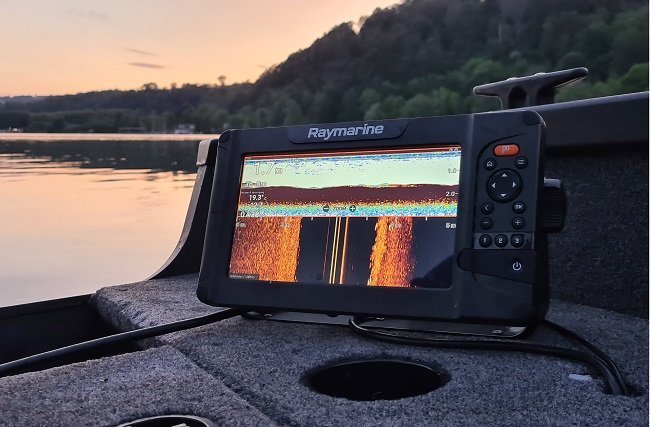
The selection of combination devices in the lower price range up to € 500 is limited to the Dragonfly series at Raymarine. Although this can fulfill many wishes, it has no flexibility, especially in the area of the transducer. With the Element series , the 7-inch model is an excellent entry into the modern world of fish finders and sea navigation from a price of € 650. Four echo sounding processes with a single all-in-on transducer are already a house number that is topped again with the high-resolution HyperVision level. The higher-end Axiom series is an all-round professional package in terms of quality and features, that leaves little to be desired with the Axiom Plus facelift. The Pro Series offers universal options with top equipment and a quality standard that can hardly be improved. If you want to glaze even larger ship bridges, you will use the Raymarine Glass Bridge multifunctional displays in XL format, which are available up to a screen size of 24 inches - then however for the price of € 15,000. Raymarine's sonar fish finder may have their price, this usually justify it.
This brings us to the end of our detailed test-review of the Raymarine fish finders and chartplotters. If you have any questions, additions or comments, please let us know – we are looking forward to your feedback - have a look at the other fish finder reviews in our extensive fish finder test (including the newest models of all important fish finder manufacturers like Garmin, Lowrance, Humminbird or Raymarine). Have fun on ypur next angling trip. “Petri Heil”! Martin and Jens.