
Lowrance fish finders: sonar technology and product families
Original publication: 2020-11-17.
Original image credits are retained. Image-use permission was confirmed by the site owner.
Lowrance knows how to build up a brand-loyal fan base among sport fishermen like hardly any other fish finder manufacturer. In this article, we will take a closer look at the reasons for this and why the manufacturer supplies marine technology and sonar devices that meet with the approval of hobby anglers and fishing professionals alike. You will also get an overview of the most important Lowrance device series and their differences.
Table of Contents
- The history and development of Lowrance
- What are the arguments in favor of Lowrance as a manufacturer?
- What are the special features of the manufacturer in terms of sonar technology?
- What does Lowrance equipment favor for anglers?
- Overview of the Lowrance fishfinder series
- What is our final conclusion about Lowrance fishfinders and depth finders?
1. The history and development of Lowrance
Since its founding in 1957, the American company Lowrance has been one of the pioneers of the marine equipment market for the leisure sector. Many innovations in the design of navigation and fish finder devices go back to the research and development work of the manufacturer.
In the course of its corporate history
- introduced a portable fish finder as early as 1959.
- With the first computer-controlled fully automatic fish finder in 1979, the basis for the development of modern fish finder and navigation technology was set,
- which led to the first combination unit with chart navigation and depth sounder functions in 1995.
Today, in a more technically mature form, we find this in all of the manufacturer's product series.
In 2006, Lowrance was acquired by Simrad Yachting and integrated into the newly formed Navico Group. Today, Navico is no less than the world's largest manufacturer of marine products for the recreational market, with Lowrance, Simrad and B&G as its mainstays.
With the introduction of the High Definition Series (HDS) in 2008, currently named HDS Live, Lowrance has taken what is currently technically feasible and put it into a series of instruments. With
- StructureScan,
- SideScan and DownScan,
- Broadband sonar
- as well as the options of 3D and real-time monitoring
practically no wishes remain unfulfilled in the sonar area. Chartplotter and navigation module operate with
- StructureMap,
- Trackback,
- Autorouting
- and all map options from Navionics and C-Map
also demanding needs.
For us as fish finder anglers, Lowrance, the top-selling branch of the Navico Group, offers a wide range of fish finders that provide complete solutions including the latest technology even in the low-price sector.
2. What are the arguments in favor of Lowrance as a manufacturer?
There are several reasons why Lowrance has become the number 1 among German recreational fishermen and why fishing forums have sometimes become "Lowrance-heavy". We would like to briefly address these in the following:
- With a headquarters in southern Norway, Navico Germany in Hamburg, the DACH responsibility in the Netherlands and the European representation in the UK, the manufacturer is ideally positioned for the German market. Short delivery and service channels for the specialized trade and German-speaking contacts ensure a smooth supply, consulting and service chain.
- Lowrance instruments are sophisticated, robust and state of the art. The range of devices is extensive, user-related sophisticated and meets customer requirements with the appropriate range of models and equipment.
- The manufacturer can draw on its own developments and innovations, which give it a certain edge over the competition in individual areas of sonar technology.
- A large Lowrance user community (forums) promotes and ensures the constant exchange of experience between individual users. This also offers fast and uncomplicated solution options outside the specialized trade for problems that occur in practical operation.
- The dealer density is highest for this manufacturer in Germany. Hardly any fish finder store will want to do without the large Lowrance customer base.
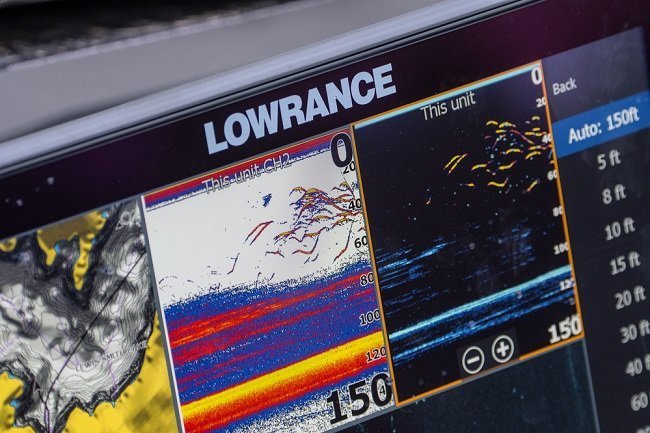
3. What are the special features of the manufacturer in terms of sonar technology?
Well, Lowrance has been and continues to be very generous in its use of new terminology to describe innovations in the instrument lineup. Active Imaging, TripleShot, StructureScan, LiveSight - to name a few - mean little to the average user at first. But they do arouse curiosity and the desire for something technically sophisticated or even unique that is worth acquiring. But is this all just a sophisticated marketing strategy or are there really outstanding technical innovations behind these lofty terms? Let's take an objective look at what is really hidden behind the individual key terms.
3.1. What does the Lowrance family of sonar transducers do?
Lowrance transducers are a classic example of new word creations that are simply given numbers by other manufacturers. So what are TripleShot, TotalScan and Active Imaging transducers?
a) What is a TripleShot transducers?
This transducer, along with the HDI types (Dual Shot?), serves the lower price level of the Lowrance family of instruments. It was introduced with the HOOK series and has remained unchanged with its third generation "Hook Reveal". As the name suggests, it can operate three (triple) different sonar signals (shots), which are:
- 2D Chirp,
- Down-
- and SideScan echoes.
So nothing out of the ordinary. Since Lowrance still uses fixed-frequency crystals for 2D chirp and transmits the down- and side-scan range without chirp, the scan results of this sonar transducer are good - but not outstanding - just in line with the price range. Nevertheless, many users are satisfied with the results, which is also due to the extrapolation (interpolation) of the signals by the device electronics. A plant residue can sometimes appear as a fish crescent. However, the devices from other manufacturers in this price range do not do this differently - just perhaps not quite as consistently.
b) What is a TotalScan transducers?
The TotalScan transducer was introduced with the Elite Ti² series and was the standard transducer for the Elite Ti² and HDS series before Active Imaging was established. De facto, it can also "only" do the three mentioned echo sounding methods:
- 2D Chirp,
- Side-
- and DownScan.
However, the sonar images are visibly better in all three methods compared to the TripleShot. Especially in the SideScan and DownScan area, which Lowrance calls StructureScan, the TotalScan scores with more detailed and meaningful images of high resolution and clean object separation. This makes the transducer interesting as an information provider for us anglers. Unfortunately, the TotalScan transducer cannot use chirp in 2D if side or down scan is desired at the same time (screen split). This is annoying and the main criticism of this type of encoder.
c) What is an active imaging transducers 3-in-1 or 2-in-1?
Under the name Active Imaging, Lowrance launched two transducers with the same name, differing only in the number of sonar functions (2D CHIRP, SideScan and DownScan for the 3-in-1, or SideScan and DownScan for the 2-in-1). The Active Imaging transducers replaced the TotalScan type for the EliteTi² and HDS series. Do not infer simultaneous CHIRP and imaging operation from the transducer name alone. Supported combinations depend on the display, connected transducers and software; consult the manual for the exact setup.
d) So what is Active Imaging?
In our humble opinion, the technology mainly represents a revision of the control options used, since both the manufacturer's announcements and other publications only discuss the performance benefits of Active Imaging, but lack technical references. For the encoders, there was certainly also slightly revised hardware.
In the end, however, that is of no importance. What matters are the results. And the manufacturer has to be complimented on that. Compared to the predecessor TotalScan, the images have improved in quality. The improvements are not only clearly visible in the StructureScan area. Even without scanning frequencies in the high-frequency format (1200 kHz), the images are among the best that the sonar market currently has to offer.
3.2. What are the features of the FishReveal Smart Target View?
The FishReveal capability was first offered by Lowrance with the re-release of the Elite-Ti series and is now a standard feature on HOOK-Reveal units and the HDS-Live series.
What is FishReveal?
A look in the dictionary reveals something (revealed), here, of course, the fish. How do you do that? Quite simply with an overlay:
You take the fish crescents from the 2D chirp,
peps them up a bit in terms of color
and implants it into the running DownScan image.
That's it, the "FishReveal Smart Target View" is done.
What does the user get out of it? Quite a lot: Never before has fish detection been so simple, informative and comprehensive in front of a detailed view of the underwater world. A stroke of genius by the manufacturer, which could be realized technically with little effort.
How does this procedure depict reality? Are these really all fish that can be seen as yellow crescents? As so often, there are differences that can be explained by how generously the echoes are interpreted by the electronics. Logically, the better the basic information provided by the transducer, the weaker the interpolation. Conversely, the hit probability would then be directly dependent on the hardware used.
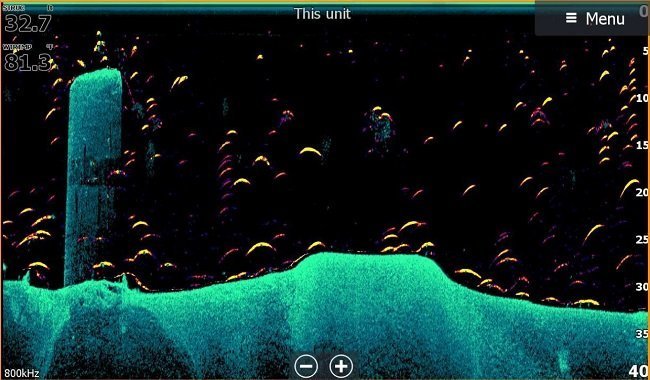
In plain language: FishReveal should definitely show the actual conditions better for HDS-Live devices with active imaging transducer than for a Hook-Reveal type with the TripleShot transducer.
3.3. What are the benefits of StructureScan 3D and Lowrance LiveSight?
Let's take two facts first.
Both techniques run exclusively with the Lowrance HDS (Live) series.
In addition, hardware extensions must be purchased for operation, at least one additional transducer per procedure.
What is StructureScan 3D?
Simply put, you take the two common StructureScan processes, pack them together, and ship them into space. The result is a three-dimensional plastic representation of the underwater world with a changeable perspective and a permanent reference to the location of the boat. The question now is no longer whether a fish is there, but where it can be found, at what distance from the boat, and at what depth above ground. This opens up completely different possibilities than in the two-dimensional Side- and DownScan that was common before.
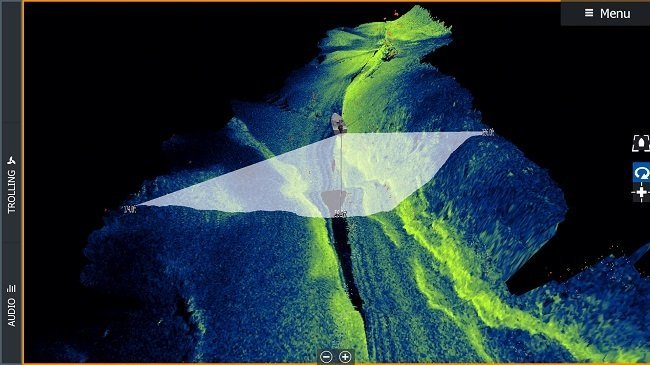
The essential information is based on the third dimension - the water depth. The differences in the scanning methods can be illustrated using a cube model. The bottom of the cube (standing surface) is the water bottom, the lid is the water surface. What happens on the bottom of the water is traced by DownScan and SideScan. This now includes all objects (e.g. fish from the mid-water) that are projected onto the ground plane by these methods. In which distance such objects stand to the bottom remains unexplained.
If we now cut the cube at an arbitrary distance and parallel to the ground, a new plane results in each case, which contains information about the state at a certain height above ground. If we now take all possible cutting planes together, we get all the information about all the objects that are in the cube. Nothing else is possible with the StructureScan 3D method. We get all the information about the modulated bottom of the water and all the objects that are above it up to the water surface. The 3D view can help locate detected structure and returns relative to the boat, but it does not guarantee detection or precise identification of every fish or feature. You now definitely know at what distance the fish is from the boat and at what water depth. What more could you want?
What about LiveSight now?
You guessed it. Something is happening live here. You now have a sight that goes live under water. Is that something special? Yes, it is. Normal sonar images always show the past. They show a location that you have already left with the boat before you see it. With Lowrance LiveSight, your HDS Live unit gives you the ability to see what's happening underwater in real time.
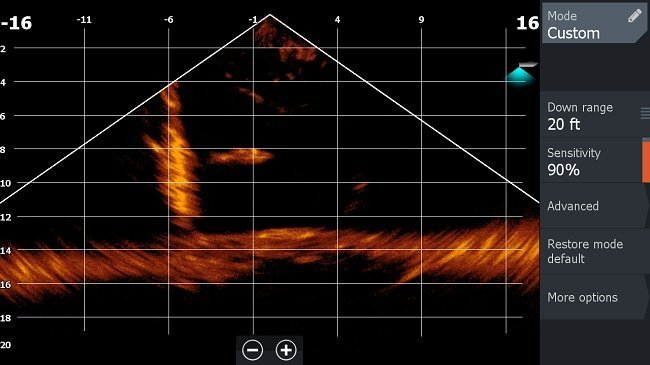
So if your pike is under the boat keel according to the interpretation of the fish finder image, it is also there at that moment. So you can follow all fish movements and of course your bait live on the monitor and react accordingly. There are two options for this:
With LiveSight Forward you light up the area in front of your boat. Being able to spot fish before (and not after) you reach the spot with your boat has surely always been your wish - not only when pelagic fishing.
With LiveSight Down, the viewing angle goes under the boat. Again, the possibilities arise to present your lure in real time and see possible reactions of your target fish to it. Who hasn't dreamed of this as an angler?
4. What does Lowrance equipment favor for anglers?
So far, we have highlighted some of the key points and features of the manufacturer's sonar technology and hopefully provided a little clarity in the Lowrance terminology. Now we want to point out some of the most important points that cause users to reach for a Lowrance sonar unit.
Many anglers and boaters are sworn to a Lowrance unit. This is not by chance. On the one hand, the manufacturer is recommended more often than average. This may be due to the large Lowrance fan community, but it is also reflected in the product quality. Hardly any user would recommend a device to others if they had a bad experience with it.
Ultimately, however, purchasing decisions are also a weighing up of the price demanded and the performance offered in return. Here, all Lowrance devices usually cut a very good figure. The qualitative features of a device are decisive. With the two sonar technologies Side- and DownScan, for example, the manufacturer has already set benchmarks in the past, which to this day - even with the inexpensive fishfinder models - secure him a certain lead over other manufacturers. It has also been able to extend this lead with the development of active imaging technology and the innovative FishReveal.
First-class quality is also delivered in the chartplotter and navigation area of its devices as soon as you choose a model from the Elite Ti2 or HDS class. With Navionics and C-Map, two chart providers are on board. Genesis Live, Navionics Live and C-Map Genesis as object-free - or bound - mapping methods round out the options for making your own charts. In addition, some Lowrance instrument features are unique among the competition, or at least not found with every manufacturer. To mention here are
- the Reveal function in all three device series,
- the 3D StructureScan option,
- the LiveSight process
- and LiveCast smartphone integration in the top models.
All these technical capabilities ensure Lowrance attention in the market.
What depth sounder and combination series can we find in the Lowrance range?
Now in its third generation, Lowrance is currently pursuing three distinct product lines, each designed to appeal to different groups of buyers.
- The entry-level range is currently secured by this year's newly launched Lowrance Hook-Reveal series. It is aimed at the price-conscious customer who nevertheless wants to be well supplied in terms of technology and equipment.
- With the Elite Ti2 series in the medium price range, the manufacturer offers the latest technology and extensive equipment. In terms of echo sounding, this reflects the current state of development in the common echo sounding methods 2D-Chirp, Down- and SideScan.
- The Lowrance HDS Live line reaches users who expect the highest performance in technology and features and require full marine network capability. Lowrance has put all of its expertise into this line. In addition to the usual fish finder techniques, these units have all the options for upgrading to 3D and real-time sonar technology. A hardware equipment of the upper class is just as natural.
5. Overview of the Lowrance fishfinder series
In the following, we will take a closer look at the three fishfinder lines of the manufacturer (Hook Reveal, Elite Ti² and HDS Live) with all their equipment details and technical finesses, so that you can choose the right fish finder for you.
5.1. Lowrance Hook Reveal Family
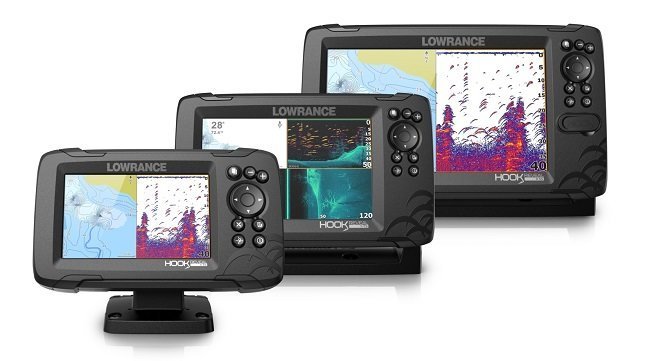
In the third generation of the Hook device series with the addition "Reveal", the manufacturer shows that you can also do a lot right in the low-cost range.
Three fish finder methods (7 inches and larger also with triple-shot transducer) with 2D Chirp, SideScan and DownScan,
a built-in chart plotter with SD card slot,
an intuitive operating system with button control,
automatic sonar fine tuning
and Genesis Live Real-Time Mapping
are the ingredients that will please every beginner but also the advanced user. As a highlight, Lowrance adds FishReveal, which combines the fish crescents of the chirp sonar with the high-resolution display of fishy structures by the DownScan Imaging.
In practice, the images in SideScan and DownScan are surprisingly good for a model in the lower price category. The conventional 2D Chirp scans correspond to the average of the device class. The chart plotter doesn't set any standards, but it works without fault in all basic functions. Of course, the hardware equipment isn't all that lavish and a few shortcomings like the missing strain relief at the ports, the fiddly card handling at the SD slot and the not optimal screen reflection have to be noted. However, they only marginally disturb the positive overall picture. The price-performance ratio of the Hook Reveal series is definitely top.
The overview of the Hook Reveal models:
Back to the table of contents| Features and functions | Hook Reveal 5 | Hook Reveal 7 | Hook Reveal 9 |
|---|---|---|---|
| Screen resolution | 800/480 | 800/480 | 800/480 |
| Screen size in inches | 5 | 7 | 9 |
| GPS | 1 Hz | 1 Hz | 1 Hz |
| SD card slot | X | X | X |
| Chartplotter | X | X | X |
| 2D-Chirp | X | X | X |
| C-Map- + Navionics-Charts | X | X | X |
| DownScan | X | X | X |
| SideScan | - | X | X |
| Genesis Live | X | X | X |
| TripleShot transducer * | - | X | X |
| HDI transducer | X | X | X |
| FishReveal | X | X | X |
| SolarMax-Display | X | X | X |
| Automatic fine adjustment | X | X | X |
| Transmitting power RMS | 500 W | 500 W | 500 W |
| Network capability | - | - | - |
| Keyboard operation | X | X | X |
| Touchscreen | - | - | - |
| Surface- / flush-mounting | x/- | x/x | x/x |
| Price incl. transducer about | 340,00 | 500,00 * | 650,00 * |
Conclusion: A lot of performance for little money. Lowrance has set a scent mark in the lower price range with the introduction of the Hook Reveal series, which should give other manufacturers something to think about. The direct competitor Garmin Striker may be hit in a sensitive spot due to the lack of a chart plotter. The Hook-Reveal series is recommended for the cost-conscious user, because it is fully equipped and can convince in the performance range price-related. For around 650 €, you are already the owner of a 9-inch Hook-Reveal device with TripleShot transducer. There is nothing to complain about.
5.2. Lowrance-Elite-Ti²-Serie (7, 9 und 12 Zoll)
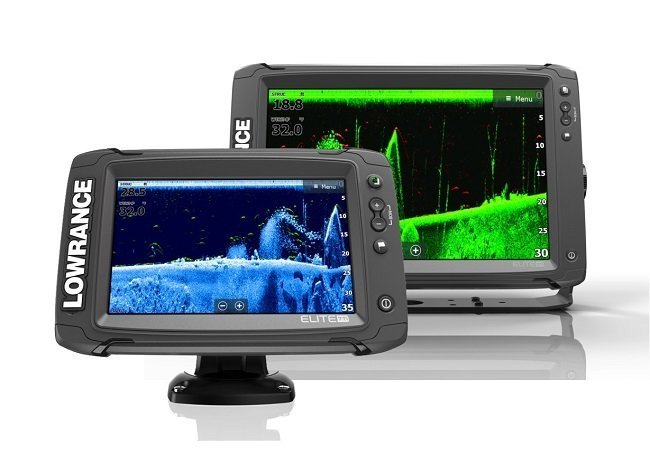
If you are a quality-conscious user looking for a device with advanced sonar features and the best scanning results, then you are on target with the Lowrance Elite Ti² series.
With the newly developed Active Imaging,
the powerful FishReveal
and the possibilities to map your waters yourself (and live),
you will find all the technical requirements to make working on the water a bit more comfortable. This also includes
a user-friendly touchscreen operation,
a communication with the outside world via WLAN and Bluetooth,
as well as the network functions via NMEA 2000.
With the new 3-in-1 (chirp, downscan and sidescan) and 2-in-1 (chirp and downscan) active imaging transducers, Lowrance has succeeded in achieving better results than were previously possible with the TotalScan model. Resolution, detail sharpness and image contrast are at their finest in all three sonar methods. This makes water assessment easier to the same degree as fish searching. Then there are the excellent navigation functions, a highly sensitive GPS (10 Hz) and a universal chart plotter that is also C-Map and Navionics compatible. Here, too, you are more than well positioned with the Elite Ti² model.
The Lowrance Elite Ti² models overview:
| Features and functions | Elite Ti² 7 | Elite Ti² 9 | Elite TI² 12 |
|---|---|---|---|
| Screen resolution | 800/480 | 800/480 | 1280/800 |
| Screen size in inches | 7 | 9 | 12 |
| GPS | 10 Hz | 10 Hz | 10 Hz |
| SD card slot | X | X | X |
| Chartplotter | X | X | X |
| 2D-Chirp | X | X | X |
| C-Map- + Navionics-Charts | X | X | X |
| Genesis Live | X | X | X |
| Active Imaging | X | X | X |
| DownScan | X | X | X |
| SideScan | X | X | X |
| FishReveal | X | X | X |
| Active Imaging 3-in-1 transducer* | X | X | X |
| Active Imaging 2-in-1 transducer | X | X | X |
| Keyboard operation | - | - | - |
| Touchscreen | X | X | X |
| WLAN | X | X | X |
| Bluetooth | X | X | X |
| Smartphone integration | - | - | X |
| Transmitting power RMS | 500 W | 500 W | 500 W |
| Network capability NMEA 2000 | X | X | X |
| Quick access | X | X | X |
| SmartSteer Control | X | X | X |
| Screen size in inches | x/x | x/x | x/x |
| Price incl. transducer about | 800,00* | 980,00* | 2000,00* |
Conclusion: Lowrance has streamlined its systems and only offers the frequently requested screen sizes in its series. At the 7-inch entry level, these are still nine- and twelve-inch devices here. Looking at the overall package, the two small 7- and 9-inch devices including the good active imaging encoder are a good deal with prices below the 1000.00 euro mark. The 12-inch variant does not have more to offer than the other two family members apart from the large display and two additional features (smartphone integration, power pole anchor and MotorGuide Xi5 motor-controllable) - but it costs more than twice as much as the next-smallest 9-inch device.
5.3. Lowrance HDS Live series (7, 9, 12 and 16 inches)
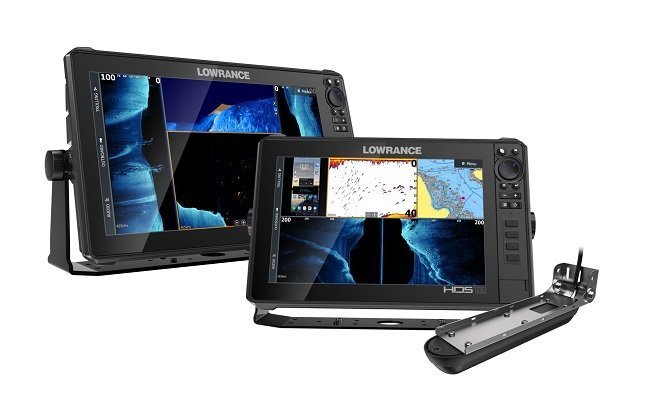
The Lowrance HDS Live series can do everything that is possible today in the fish finder and navigation area of the recreational market with high quality equipment. Of course, we move in the basic fish finder configuration with Chirp, Down- and SideScan, but can also work in the 3D StructureScan method and use the sonar in real time.
Anyone who wants this must purchase additional accessories besides the device purchase with the active imaging transducer. LiveSight is installed as standard in the HDS Live series. However, the matching LiveSight transducer is additionally required, which costs approx. 1200.00 €. For the StructureScan 3D option, a set of transducer and black box must be connected, which costs around 1000.00 €. All in all, the additional expenditure is well over 2000.00 € - about as much as is on the shopping list for an HDS Live 9-inch with active imaging transducer.
In plain language, this means that an HDS device with the Active Image transducer is nothing more than an Elite Ti2 device with upgraded components (monitor, hardware, LiveSight, equipment) that can handle the three basic fish finder techniques (2D Chirp, SideScan and DownScan). Other manufacturers similarly tune their upper-class devices, such as seen at Garmin with the GPSMap series and the Panoptix / Livescope technology. Basically, there is nothing wrong with this. For a manageable additional price, you get top-class hardware (SolarMax HD screen, dual-core processor, LiveSight, etc.) and more features (SD card slots, dual operating concept, advanced online functions, marine network integration) - which justifies the investment at all times. In terms of sonar technology, however, nothing happens outside the basic range without additional purchases.
Lowrance HDS Live: models, equipment and compatibility:
- - not available,
- x present
- and o compatible
- * Accessories necessary
| Features | HDS LIVE 7 | HDS LIVE 9 | HDS LIVE 12 | HDS LIVE 16 |
|---|---|---|---|---|
| Solar-Max-HD-Display | x | x | x | x |
| 6-fold split screen | – | – | x | x |
| Touchscreen MultiTouch | x | x | x | x |
| Additional key functions | x | x | x | x |
| Additional access keys | – | – | x | x |
| Live marine network | x | x | x | x |
| Live sonar network | x | x | x | x |
| LiveCast | – | – | x | x |
| HDMI and USB port | – | – | x | x |
| WLAN, Bluetooth | x | x | x | x |
| Smartphone integration | – | – | x | x |
| Quad Core CPU | – | – | x | x |
| Dual Core CPU | x | x | – | – |
| Active Imaging | x | x | x | x |
| Active imaging transducer 3-in-1 | o | o | o | o |
| Active imaging transducer 2-in-1 | o | o | o | o |
| Airmar transducer | o | o | o | o |
| DownScan 800/455 kHz | x | x | x | x |
| SideScan 800/455 kHz | x | x | x | x |
| LiveSight real-time sonar* | x | x | x | x |
| StructureScan-3D-AI* | x | x | x | x |
| Chirp Traditional 2D | x | x | x | x |
| 2-channel chirp integrated | x | x | x | x |
| Chartplotter integrated | x | x | x | x |
| GPS 10 Hz | x | x | x | x |
| C-Map- and Navionics nautical charts | o | o | o | o |
| Live Mapping | x | x | x | x |
| SD card slot 2-fold | x | x | x | x* |
| *Accessories necessary |
Conclusion: With the HDS Live 7 and the decent active imaging transducer (3-in-1), you can enter the upper class of Lowrance for around 1300 €. You get a high-quality device with good equipment. In this configuration, the basic fish finder techniques (2D-Chirp, Side and DownScan) can be used. With FishReveal, a functional MultiTouch screen with key support, a 1A chart plotter and the live mapping functions, you are hardly better off than with a corresponding Elite Ti² device, if you disregard the qualitatively higher overall equipment (SolarMAX-HD, dual-core processor, etc.) of the HDS devices. The HDS Live series can only clearly stand out from the rest of the field when 3D StructureScan and the real-time options are used. But then additional investments are necessary. Additional transducers and the black box for 3D increase the installation effort, but this is certainly worthwhile in marine network applications and fixed installations with several devices.
6. What is our final conclusion about Lowrance fishfinders and depth finders?
The best fishfinder: Ultimately, the Lowrance fish finder range covers the complete spectrum of possible user needs and preferences.
Inexpensive and already quite fully equipped you are with the Hook Reveal series. This brings all the basic sonar techniques at class level and the prerequisites for a solid lake navigation. For 650 € you are already in the 9-inch range.
If you want more equipment, you can increase the quality significantly with the Elite Ti² series. Active Imaging with the right transducers makes it possible. Equipment comfort and scope also increase in this device series. In the 9-inch range, you can still get by with a transducer under the 1000-euro mark.
Top performance and full marine network integration await you in the HDS-Live series, which lives up to its claim in all respects. For a 9-inch model, however, you have to reckon with twice as high costs (2000 €) in the HDS-Live series with the same encoder use. If you still want to scan in 3D and live, you won't be able to avoid a considerable surcharge from your petty cash.
This brings us to the end of our detailed test-review of the Lowrance fish finders and chartplotters. If you have any questions, additions or comments, please let us know – we are looking forward to your feedback - or have a look at the other fish finder reviews in our extensive fish finder test (including the newest models of all important fish finder manufacturers like Garmin, Lowrance, Humminbird or Raymarine). “Petri Heil”! - Martin and Jens.