
Zander Fishing · The Year-Round Cycle
Where Are Zander Throughout the Year—and What Changes First?
Why Do Zander Follow Their Prey Rather Than the Calendar?
A productive zander hotspot in May can produce many blank days in October. That is not a contradiction, but the result of a dynamic body of water: vegetation grows or dies back, forage fish change depth, the water mixes, and light and oxygen levels change. Anyone who blindly fishes the same drop-off all year is often testing habit—not the current habitat.
The zander population is not a single closed group. Some fish may remain at suitable structure for a long time, while others move between open water, drop-offs, and shallow feeding zones. Therefore, in the same lake, one zander may hold on a hard-bottomed plateau while another follows forage into a bay. The better question is: What change brought the forage into this zone today—and how can the zander reach it?
Work with a testable hypothesis: “Small forage fish are holding along this drop-off because wind, light, or temperature creates an advantage here.” Only then should you consider soft plastics, jigheads, and color. If the forage is absent, change the zone first—not just the lure.
Where Are Zander in Spring?
After winter, no body of water warms evenly. Shallow bays, sunny banks, sheltered areas, and tributaries may concentrate food earlier than the deep main basin. Water mixes more strongly in rivers; calm side areas, oxbows, groyne fields, or inflows may provide the first plausible direction for your search. The shallowest water is not automatically productive; what matters is the route forage can use to move between deeper refuge areas and shallower water. Zander Fishing in Spring explores the specific process in greater depth.
Traditional zander knowledge rightly emphasizes that zander do not gather randomly in spring but seek specific spawning areas. This information is not an invitation to fish such places. It explains why the first steep drop-off, a channel, or an area of reduced current outside sensitive areas after the closed season may be more productive than the visible shallow water itself.
After spawning, the population disperses again. Some fish remain nearby, while others move to forage-rich drop-offs or adjacent deeper water. Therefore, the first area outside the spawning grounds that combines food, cover, and a clear route back is a better starting hypothesis than searching for a fixed spring depth.
What Does the Spawning Season Mean for Finding Zander?
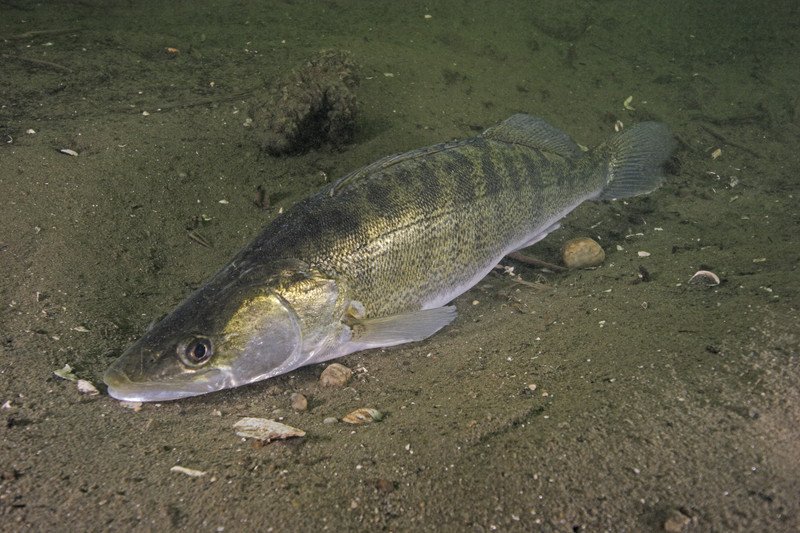
Zander (Sander lucioperca) do not spawn under identical conditions everywhere. Depending on the body of water, substrates may include gravel, sand, mud, wood, or other structured areas. Light, temperature, water level, and visibility influence where nesting sites are viable. The old article mentions depths ranging from a few meters to considerably deeper; this expressly does not establish a “spawning depth for fishing.”
After the eggs are laid, the male remains at the nest and guards them. This is precisely why fish may react to stimuli during this phase without it being a feeding strike. The practical conclusion is clear: check local closed seasons, protected areas, and fishery regulations; leave known spawning grounds undisturbed; and do not publish coordinates or photos that could lead others there. Sustainable zander fishing begins by not making the next generation a fishing target.
Where Are Zander in Summer?
In stratified lakes, warm surface water, a transition zone, and colder deep water develop. The thermocline is not automatically a zander line. In nutrient-rich waters, deep water may become oxygen-depleted; forage and zander then tend to remain above the problematic zone. In clear, deep, oxygen-rich lakes, accessible depths may differ. The type of water and forage also influence where fish hold.
When using sonar, do not look only for a temperature boundary, but for a relationship: forage over hard bottom, at the edge of a plateau, along a drop-off, or in open water. Mobile zander may follow schools of juvenile fish and occasionally appear at underwater humps. More stationary fish are more likely to use prominent structure, shade, turbid water, or cover as feeding areas. The Zander Cornerstone helps distinguish between these two search strategies.
At twilight, zander may move shallower in some waters. This is a window of opportunity, not a guarantee. Always ask whether forage is actually active there. A compact lure that remains at the correct depth for longer may be more effective than a large soft plastic that quickly jumps past the forage layer.
Why Does Fall Change Zander Hotspots?
Fall is not simply “zander season,” but the result of a series of changes. Vegetation thins out, the surface cools, wind mixes the water, and forage may move from shallow summer areas to drop-offs, channels, or open water. Underwater humps with adjacent deep water, hard-bottom transitions, deep channels, and the edges of forage schools therefore become good initial hypotheses.
Choose lure size based on the actual forage. If small smelt, bleak, or juvenile fish dominate the water, a very large lure is not automatically plausible. If larger forage is present and the zander are active, a larger lure may make sense. Lure presentation and dwell time follow from the forage hypothesis—not the other way around.
What Happens During the Fall Turnover in Zander Waters?
In deep lakes, summer stratification may separate different zones for a long time. As the surface cools and wind mixes the water, temperature and oxygen are redistributed. Areas that were unsuitable in summer may become accessible again, while a previously distinct forage layer disperses. Small, shallow waters generally respond faster than large, deep lakes.
The old article warns of two to three difficult weeks on large, deep waters. This duration is not a fixed rule. It depends on depth, wind, weather, and the shape of the waterbody. Observation is what matters: a sudden temperature change, a dispersed sonar image, migrating forage, or a lack of contacts along familiar summer lines. In that situation, test several transitions and do not expect the old spot to work again immediately.
Where Are Zander in Winter?
At low temperatures, it may pay to fish a suitable area more thoroughly rather than more quickly. Controlled bottom contact, small hops, and longer pauses keep the lure in the suspected strike zone longer. When gently lifting the soft plastic, raise it only slightly; large hops reduce the time in front of the fish and make depth harder to control.
This does not mean that zander are motionless in winter. If forage is holding along a shallower drop-off or in a channel with reduced current, the predator may be there too. If the forage is mobile, you need to search actively. The key test remains: Does your lure reach the suspected depth and stay there long enough?
How Do You Plan a Zander Fishing Day by Season?
| Phase | Initial Search Area | What to Confirm |
|---|---|---|
| Spring | Bay entrance, tributary, transition to winter depth | Temperature trend, forage movement, protection regulations |
| Summer | Forage layer, drop-off, open water, shade | Oxygen, light, and actual fish depth |
| Fall | Channel, underwater hump, hard drop-off, edge of a school | Cooling, vegetation changes, stability |
| Winter | Remaining structure, deep transition, hard bottom | Forage and prolonged contact time |
- Record the change: Observe temperature trends, wind, visibility, water level, and forage.
- Classify the waterbody: Account for whether it is a lake, reservoir, or river, as well as clear or turbid conditions.
- Justify three zones: For example, a bay entrance, a drop-off, and a forage layer in open water.
- Test depth and angle: Fish the suspected attack line instead of randomly changing lures.
- Change one variable: Adjust depth first, then angle, then presentation, and finally contrast.
- Record the result: Document contacts, forage, and environmental conditions.
One blank pass does not prove that the lure was wrong. The zone may have been empty, the forage too mobile, or the lure outside the strike window. If you change only one variable, you can learn from your observations for the next session. The annual cycle does not guarantee a catch. It helps you ask the more useful question before your first cast: What change brought the forage to a different structure or depth today?
Sources and adapted material: This article expands on the existing WordPress post “Top Hotspots for Zander Fishing—All Seasons” and retains its seasonal overview and the image of a zander nest in the spawning section. The technical basis is Modern Fish Finding—Zander, supplemented by Lure Knowledge. Depth, temperature, and seasonal patterns are water-specific guidelines, not catch formulas. Before fishing, check the closed seasons, protected areas and fishing rules that apply to your location and chosen water.