
Carp Fishing · Feed and Science
How to Feed Carp Properly: Which Amino Acid Do They Prefer?
Why are amino acids in carp feed interesting?
Amino acids are produced by the body or absorbed through food. They are involved in building proteins, metabolism, and other bodily functions. That is why they are found in carp food as well as in many feeds and attractant concentrates.
As a carp angler, it is easy to be tempted to add a concentrate to your feed based on the idea that “it contains everything carp need.” This is precisely where the scientific study becomes interesting: If carp taste individual dissolved substances differently, indiscriminately mixing them in may even work against the actual goal.
The question, therefore, is not only whether a substance is essential to the fish. What matters is whether a carp perceives it, how long it keeps a pellet in its mouth, and whether that actually results in ingestion.
How was the study conducted?
The carp were initially kept in communal aquariums at 16 to 17 °C for three to four months and fed frozen bloodworms. The scientists then trained the fish to eat pellet feed over several days. Only then did the actual comparison begin.
Each pellet contained only the substance being tested. A solution of water and bloodworms served as the control. The pellets were offered in random order so the carp would not become conditioned to a particular mixture. They were also dyed red so consumption could be observed clearly.
Two things were measured: How often was a pellet taken? And: How long did it remain in the mouth before the carp swallowed it or spat it out? Each amino acid was tested between 80 and 109 times. This makes the study notable as a taste experiment—even though an aquarium is not a lake.
Which amino acids performed best?
| Additive | Consumption in the experiment | Time in the mouth | Assessment |
|---|---|---|---|
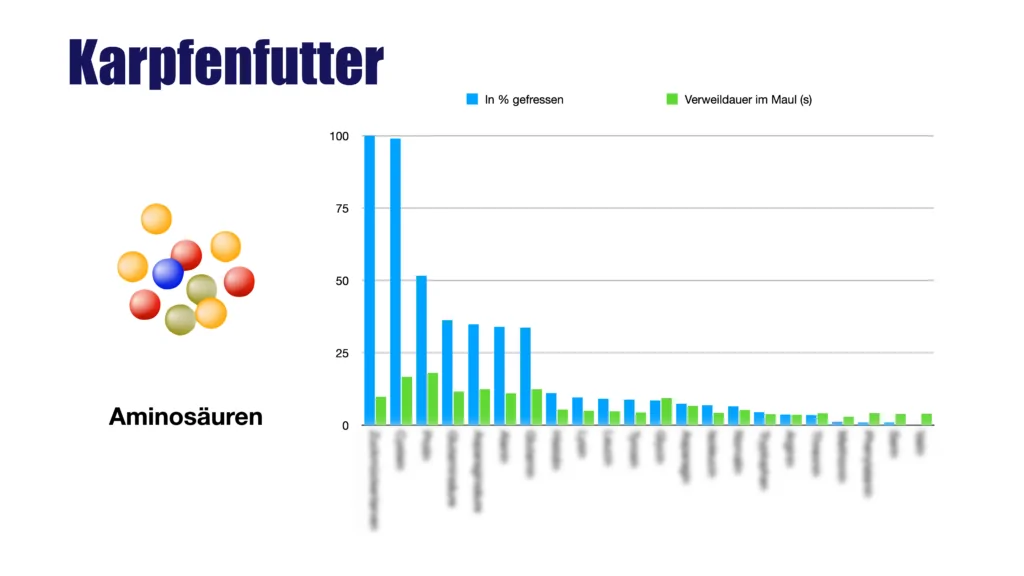
| Cysteine | 99 % | 16.7 seconds | clearly the strongest stimulus tested |
| Proline | 50 % | more than 18 seconds | frequently taken, examined for a long time |
| Glutamine | 33 % | 12 seconds | stimulating response |
| Alanine, aspartic acid, glutamic acid | stimulating | not highlighted as individual values in the article | second group |
| Arginine | approximately 4 % swallowed | usually 1–2 seconds | frequently spat out again |
The figures are impressive, especially for cysteine: 99 % of the pellets were taken and remained in the mouth for an average of 16.7 seconds. For proline, 50 % of the pellets were eaten; at the same time, the carp examined the pellets for an especially long time. Glutamine had a 33 % consumption rate and remained in the mouth for about 12 seconds.
This time in the mouth is a separate metric in the study. It does not mean that a carp on the hook will reliably be detected within 16.7 seconds or that a hookset will automatically succeed. A pellet in an aquarium is not the same as a baited hair rig in natural waters.
What do the three groups mean?
The first group included histidine, lysine, leucine, tyrosine, glycine, asparagine, isoleucine, and norvaline. On average, these additives were eaten in only 6 to 11 % of cases. The pellets remained in the mouth for about 4.3 to 9.4 seconds before being swallowed or spat out.
Interestingly, four of these eight amino acids are partially or fully essential. This illustrates the important difference between “necessary for the body” and “especially palatable as an additive”. A substance can be physiologically important without working particularly well as an isolated attractant.
The second group included cysteine, proline, glutamic acid, aspartic acid, alanine, and glutamine. These additives had a stimulating effect. The third group included seven amino acids whose pellets were spat out especially often. Arginine, for example, was swallowed in only about 4 % of cases; in 96 out of 100 cases, the pellet was spat out again after approximately one to two seconds.
This is no reason to label a substance as categorically “off-limits” or to call every product containing cysteine superior. It indicates that the composition of a feed should be evaluated more carefully than by simply reading its ingredient list.
What can be applied on the water?
A carp must first reach your feeding spot. Temperature, oxygen, depth, wind, water level, vegetation, and natural prey determine where it searches. What good is the most intriguing attractant if the carp is feeding in the wrong place? That is why analyzing the body of water comes before feed chemistry.
If you find a plausible feeding zone, an amino acid additive can be one part of your test. But change only one thing at a time: the same rig, the same amount, the same position—and initially, only the additive. This at least allows you to roughly assess a response. If you change the boilie, feed amount, depth, and time of day simultaneously, all you are left with is a feeling.
In clear, heavily fished water, a subtle stimulus may be more useful than an aggressive attractant. In murky or moving water, a dissolved stimulus may disperse differently. Temperature and natural food also change the situation. The laboratory values are therefore a starting point for a hypothesis, not a ready-made rule for the water.
How much feed should you use?
In cold water, with few fish, or during a short session, a large carpet of feed can do more harm than good. Natural food is often already available, and carp do not have to take every additional stimulus. The amount may differ in warm water or when several fish are actively feeding.
Do not automatically feed more just because no movement is visible. First check whether the fish are at the next drop-off, at another depth, or near a natural food source. Feed amount follows activity—not impatience.
The spot matters too: A small, precise trail of feed along a mussel bed, weed edge, or area of soft bottom may make more sense than a large pile on empty hard bottom. Feed keeps a likely zone interesting for longer; it does not produce carp out of nowhere.
What can the study not answer?
The carp lived in aquariums, received standardized pellets, and encountered additives individually. In a lake, current, dilution, bottom composition, natural food, competition, angling pressure, and pressure on the body of water also play roles. In addition, no finished boilies, particle mixes, or fishing rigs were compared under real-world conditions.
Nor should “99 % eaten” be confused with “99 % more fish caught.” The study measured consumption of the test pellet. It did not measure the number or size of carp caught, or hookset success. This clear distinction makes the data more credible, not less interesting.
The original article deliberately presented the results in striking terms. For a modern version, we place enthusiasm for the study alongside its limitations: Cysteine is the clear winner of this experiment, but it is not a universal promise for every fishing situation.
How do you test effectively?
- Justify the location: Select a drop-off, weed bed, mussel bed, soft bottom, or area where food enters the water.
- Record the conditions: Note the water temperature, wind, water level, depth, and time of day.
- Maintain a control: Initially keep the feed type and amount constant.
- Test additives individually: Do not change cysteine, proline, or another mixture at the same time as other factors.
- Check the response: Observe bubbles, contact with the bottom, time spent at the spot, and repeated visits.
- Interpret the result: Do not treat a single catch as proof, but treat recurring patterns as signals to learn from.
The goal is not to find a secret ingredient that fools carp everywhere. The goal is to better understand when a feeding stimulus fits a natural feeding situation. The best amino acid remains worthless if prey, temperature, and location are not right.

The full feeding strategy is in the Carp Book.
Modern Fish Finding—The Carp combines studies on food, feed, bodies of water, and seasons with the question of where you should offer your bait in the first place.
View the Carp Book later → (German-language edition; English edition coming soon)You can find the location basics in the Carp Overview and the article Where Are Carp in Spring?. The reproductive phase is covered in the article Carp Spawning Season.
Source basis: The existing article How to Feed Carp Properly, the study described there on the sense of smell and taste in carp, and Modern Fish Finding—The Carp. The laboratory values are not presented as a guarantee of catches. Technical review, a source link to the original study, image rights, and regional notes will be completed before later publication.