
FINDING ZANDER · NATURAL BAITS
When Is a Dead Baitfish Right for Zander—and When Should You Use a Bottom Rig or Float Rig?
When Is a Dead Baitfish a Sensible Choice for Zander Fishing?
The existing article describes fishing with dead baitfish as closely matching the zander's natural hunting behavior. That advantage remains: A real fish provides shape, scent, and a subtle presence without requiring you to constantly impart action with the rod. This is particularly useful when you want to thoroughly fish a drop-off, quiet pocket, or clearly defined area for an extended period.
But baitfish does not solve the location problem. If it lies in empty water, it remains merely an attractive bait. Zander often hold in very specific areas: at the base of a drop-off, in a channel, around a pile of rocks, at an inflow, or on the edge of a current zone. Your first task is therefore the same as when fishing a soft plastic: connect prey, structure, and an accessible zander holding spot.
Use only permitted baitfish presented dead, and check the rules governing the body of water, fish species, origin, harvest, and hooks before your session. This protects the fishery and prevents a good fishing idea from violating local regulations.
Where Should You Place a Baitfish for Zander?
In lakes, plateaus, steep drop-offs, old channels, rock piles, submerged trees, or bay entrances can be good starting points. In rivers and canals, current seams, the downstream ends of groynes, inflows, harbor walls, and calmer areas beside the main current are also important. The original article identifies precisely these deviations from a body of water's usual contours as promising zones. Not every one of them always holds fish—but each can provide a plausible hypothesis.
Place the bait where zander can reach it without swimming an implausible route. In a lake, this could be the base of a drop-off; in a river, the quiet side of a current seam; and in a canal, a hard edge beside a deeper channel. Then check whether prey, depth, and cover align. Learn more in Zander Hotspots in Lakes and Rivers.
Practical test: Rather than placing two baitfish ten meters apart, put them at two different functional features: one directly at the base of the drop-off and one along its side or in the quieter adjacent zone. This lets you compare not only two distances, but also two potential holding spots.
What Baitfish Size and Shape Are Suitable for Zander?
The original article recommends avoiding deep-bodied baitfish and suggests lengths of up to approximately ten centimeters as a starting point. It also refers to studies of zander stomach contents in which small prey fish occurred frequently. This is useful guidance, but not a strict upper limit. A small perch, roach, rudd, or smelt can be plausible prey depending on the water—provided that it actually occurs there and is legal to use as bait.
Look at the water first: Which fish do you see at the surface, along the bank, or on your fish finder? Which juvenile fish are holding by the vegetation, and which slender baitfish are moving over the drop-off? You can then make an inference: If many small, slender fish are currently present, a baitfish with similar proportions could be a sensible first test. It is an experiment, not a guaranteed formula for catching fish.
Also choose the size based on the presentation. A small bait can be presented with greater control along a subtle drop-off; a larger bait may remain visible or detectable by scent for longer at a deep, calm spot. What matters is that your rig holds the bait naturally and that you do not choose one that is too large or too small merely out of habit.
When Is a Bottom Rig Useful for Zander?
The original article describes a bottom rig with a running sinker, swivel, and leader as a simple presentation. Its strength lies not in complexity, but in control: The weight must suit the bottom and the current. If it is too light, the bait drifts out of the zone. If it is unnecessarily heavy, you lose sensitivity and create an unnatural bait path.
In still water, you can deliberately place the bait beside structure and keep it there. In a river, choose the angle and weight so the current does not sweep the bait into the main flow. Do not simply leave it lying somewhere without a plan. A baitfish on the bottom still addresses a specific question: Is the zander holding here at this transition, or is it using the next line?
The hook rig must suit the bait, presentation, presence of northern pike, and local regulations. More important than a blanket recommendation for hook orientation is avoiding deep hooking and planning your hookset and rig responsibly. If in doubt, the fishery rules, a tackle shop, or an experienced angler familiar with that specific water will be more helpful than an online formula.
When Is a Float Rig Useful?
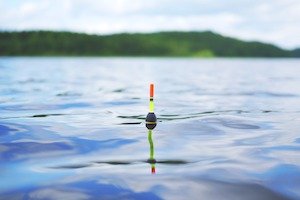
The original article describes using a float to keep the bait approximately one meter above the bottom and allowing gentle movement or current to work it. That is precisely its advantage: You can present a bait above silt, vegetation, mussels, or uneven bottom without it immediately disappearing or becoming snagged.
The float also indicates movement at the spot. A zander may initially inspect a bait. A twitching or moving float is therefore not automatically a cue for a frantic hookset. Watch whether contact continues, and use a rig designed for quick, fish-friendly hook contact. The exact timing depends on the hook, bait size, and presentation—giving a universal number of seconds would be irresponsible.
Our assessment: If prey is suspended above a drop-off or a gentle current passes a quiet seam, the float could provide a better bait path than the bottom rig. The test is simple: Use the same zone and comparable bait sizes, presenting one on the bottom and one above it. Then compare not only bites, but also visible signs of prey and contact.
How Should You Respond to a Bite When Fishing with Baitfish?
The existing article explains that zander may inspect, pick up, turn, or carry a bait. This observation shows why a pull on the line does not always look the same. But it is no reason to let the fish swallow deeply. Plan the rig so you can detect bites and respond responsibly; check hooks regularly and unhook caught fish as gently as possible.
Preparation remains the most important factor: unobstructed line travel, a rod within reach, a clearly chosen spot, and no unnecessary noise on the bank. The original article emphasizes how wary zander can be when disturbed. Whether every sound immediately drives a fish away cannot be stated categorically for your particular water. Nevertheless, staying quiet is a sensible practical rule: You can observe more effectively, maintain better control of the rig, and disturb your area less.
Baitfish or Soft Plastic—which Is More Suitable?
With a soft plastic, you can quickly test different angles and depths. This is effective when you first need to determine whether the fish are holding at the base of a drop-off, on the slope, or on its shallower side. Baitfish can make sense once the search zone has been narrowed and you want to offer natural prey there for longer. That does not make it “better,” just different.
Rather than pitting the two methods against each other, use them in a sensible sequence: If you are still searching, you can use a soft plastic to read structure and depth. Once you have confirmed a plausible, quiet zone, a baitfish can be the next test there. The active variations are covered in the article Jigging, Bottom Hopping, and Lifting.
What Does a Responsible Baitfish Plan for Zander Look Like?
- Rules first: Check permitted baitfish species, origin, quantity, hooks, and fishing seasons for the water.
- Read the prey: Observe the fish species present, as well as the size and depth of the prey.
- Justify the holding spot: Select a drop-off, channel, calm current zone, or edge holding prey.
- Choose the rig based on the bait path: Use a bottom rig for a clearly defined bottom area and a float for a specific depth.
- Test one variable: Change the location or depth first, then the bait size, and other details only afterward.
- Consider fish welfare: Plan bite detection, hooks, and hooksets to avoid deep hooking.
A dead baitfish is not a trick that makes an empty spot productive. It can be a very precise, natural presentation if you first understand where zander can reach their prey. That is when the choice between a bottom rig and a float becomes logical—and you are fishing not just with baitfish, but with a plan.