
FINDING ZANDER · READING THE WEATHER
What Air Pressure Is Good for Zander Fishing—and What Does the Trend Really Tell You?
Why isn't a single hPa reading a signal that fish will bite?
The existing article begins with an experience many anglers know: When the weather remains consistent for an extended period, the day often feels more predictable. When conditions change quickly, bites become harder to come by or a familiar spot suddenly seems empty. This experience is valuable—but it becomes useless when turned into a magic number.
A barometer measures the air pressure over your body of water. It does not explain where the zander are holding or whether they are feeding. Two days with the same reading can be completely different: One may be overcast, windy, and murky; the other clear, calm, and sunny. The season, water temperature, water level, and distribution of baitfish may also differ. That is why an hPa reading cannot replace observing the water.
A better way to think about it is: The pressure trend can reveal a change in the weather. And a change in the weather can alter light, wind, temperature, water level, and baitfish activity. That is where your fishing plan begins.
What does an air pressure trend tell you when fishing for zander?
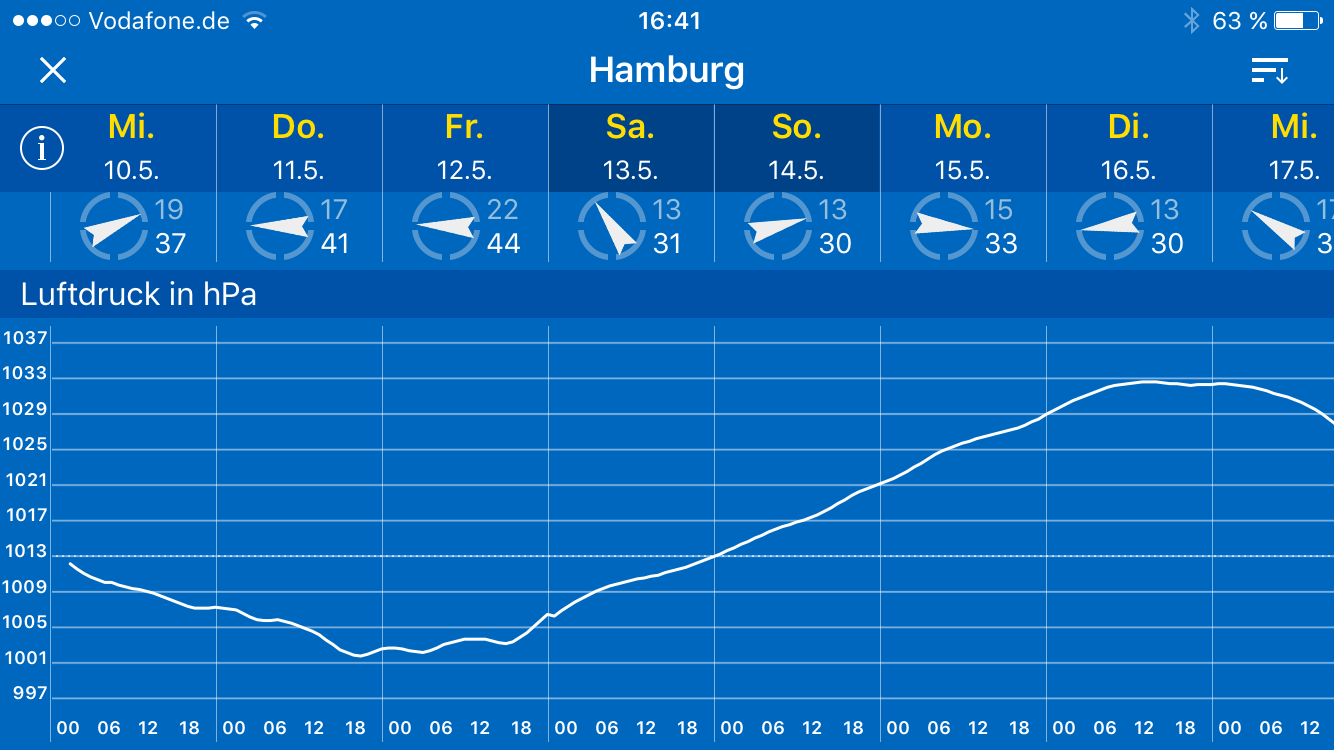
The old graphic illustrates the practical benefit: You can see a trend over several days, not just the reading on your watch. A stable period, a slow rise, or a sharp change are initially just observations. They help you compare today's session with other sessions later.
Alongside it, record what you actually saw at the water: wind direction and strength, cloud cover, visibility depth, water level, water temperature, and signs of baitfish. After several trips, you may recognize a pattern: On your canal, overcast afternoons following a period of settled weather may produce well. Or on your clear lake, activity may not begin along the drop-off until dusk. That would be your pattern—not a universal rule for every zander angler.
What does a change in weather alter underwater?
The existing article already presents the key idea: It is not only the pressure itself, but the associated change in weather that can reposition both prey and predatory fish. That is the more useful basis for practical fishing. After warm days, shallower areas may become more attractive. Wind can change how the water moves and darken the surface. In rivers, rain, water level, and current can further change the rules.
Our assessment: If baitfish change zones because of light, temperature, or water movement, zander may follow them to the nearest suitable transition. This could be a drop-off, the edge of a weed bed, an inflow, a current seam, or the deeper side of a bay. This conclusion is deliberately a hypothesis. You confirm it not with the weather forecast, but with signs of prey, sonar images, or repeatable casts.
Especially during major changes, it pays to let go of your usual “best spot” mindset. Perhaps the spot has not become bad—the prey are simply somewhere else today. The article Where Do Zander Hold in Lakes and Rivers? will help you choose the next plausible zone.
Why should you always start with the prey, even when considering the weather?
A zander must expend energy to attack. The existing article concludes that predatory fish may be easier to catch when current conditions give them an advantage over their prey. Whether this advantage comes from twilight, murky water, structure, current, or suitable prey size depends on the body of water.
Actively look for what has changed: Are bleak holding in the wind shadow? Are baitfish suspended over the base of a hard drop-off? Have small perch disappeared from the shallow weeds? Is there a calmer seam in the river where prey do not have to swim against the main current? Your answer determines the zone first and the lure color second.
Practical test: When the weather changes, choose two contrasting areas: an exposed drop-off affected by wind and a sheltered, calmer structure. Fish both with the same lure size and a comparable lure path. Only after you know where prey or a bite appears should you adjust the presentation.
Is stable weather always better for zander fishing?
The old rule of thumb about “two or three stable days” is understandable as a planning aid: Underwater, a predictable distribution may have reestablished itself. In practice, however, it should not become a reason to stay home as soon as the trend fluctuates. Zander can still be caught on a changeable day—just perhaps not in the same spot, with the same lure, or at the same time as on the last stable day.
Stability is especially helpful for learning. When several variables remain consistent, you can better understand why a particular spot, angle, or lure path works. Under rapidly changing conditions, you need a more detailed log: What exactly did you observe, when, and where? This prevents you from attributing success or failure to air pressure when it was actually caused by prey, visibility, or structure.
How do you fish when air pressure fluctuates?
For difficult days, the existing article suggests various presentations: working the lure more aggressively along the bottom, slowing down, letting the lure sit still, or using more contrast in murky water. These ideas remain useful options. The order is what matters. A faster hop may work along an active drop-off; a slower, subtle movement may work better in a calm pocket. A lure left on the bottom may appeal to a stationary fish—or simply lie outside its path.
Do not fish more aggressively, slower, larger, smaller, and brighter all at the same time. You will learn nothing that way. Choose a basic hypothesis: “The prey are holding deeper at the base of the drop-off today.” Test it with controlled bottom contact. If it produces no evidence, change the depth or move to the next structure. Only then should you change the lure action.
Natural baits can also be an option on difficult days if they are permitted on the body of water and presented properly. The old article mentions them because of their scent and taste. This is not a trump card either, but another test: Is a stationary baitfish better suited to a stationary zone than an actively worked soft plastic?
Which lure presentation should you test first during weather changes?
At the base of a drop-off or in a calm river seam, a controlled presentation near the bottom is often the cleanest first test. When bottom hopping with the reel, you move the lure by retrieving line. When jigging, the rod creates the hop. When gently lifting, you raise it only slightly and give it time to return to the bottom. All three techniques make sense when they intersect the suspected attack path.
A change in weather does not automatically determine the technique. It may, however, change your hypothesis: In murky water, slightly stronger contrast may be worth testing. Along a calm, clear drop-off, a smaller movement may be more plausible. After the session, do not just write “pressure fell,” but also: Where did the lure travel? How long did it remain in the zone? Were there signs of prey, following fish, or bites? For these types of movement, see the guide to jigging, bottom hopping with the reel, and gently lifting.
How do you use air pressure and weather data effectively for your next session?
- Check the trend: Record whether it is stable, slowly rising, slowly falling, or changing quickly.
- Add the water conditions: Observe light, wind, turbidity, temperature trend, water level, and current.
- Formulate a prey hypothesis: Where might baitfish hold under these conditions?
- Test two or three zones: such as a windblown drop-off, a sheltered transition, and an adjacent deeper area.
- Define the lure path: Deliberately choose depth, bottom contact, casting angle, and presentation.
- Change only one variable: Depth before presentation, presentation before color.
- Record the result honestly: Even an empty but thoroughly tested area is a valuable observation.
In the end, the best air pressure is not the reading an app marks in green. It is the weather pattern you have understood in the context of your body of water. If you connect prey, structure, and lure path correctly, even a difficult day becomes a better test—and your next session will not start from scratch.