
Perch Fishing · Spring
Where Are Perch in Spring—Before and After Spawning?
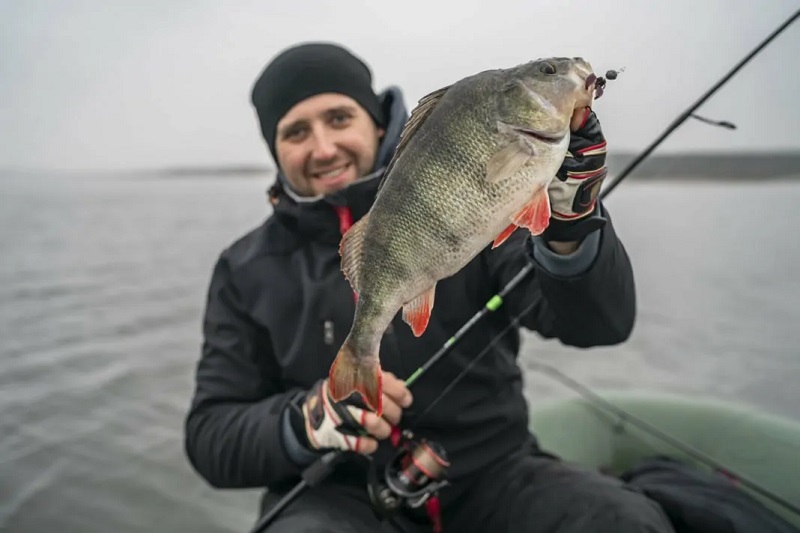
What Changes First in Spring?
“Spring” is not a uniform condition for perch. A small, shallow lake warms differently from a deep gravel pit. Wind, tributaries, shoreline color, shade, and water turbidity determine where the first temperature advantage develops. Day length and the location of the body of water also shift the timing; the studies described in the book document spawning events in different regions and time frames.
Therefore, start with the section of water most likely to warm up or collect food. This could be a shallow southern or western shoreline, a tributary, a windward drop-off, or a transition connecting deep winter water with the shallows. A single reading is less useful than the trend: Does it get warmer there over several days, does forage remain accessible, and does the structure provide cover?
The useful classification is therefore not “March through June,” but before spawning, during spawning, and after spawning. The same bay can serve a different purpose in each phase: first as a travel route and staging area, then as spawning habitat, and later as a feeding area for juvenile fish and invertebrates. Anyone who knows only one spring depth will miss this change.
Where Are Perch Before Spawning?
Before spawning, energy requirements increase. Perch do not have to move immediately into shallow shoreline areas; the routes there and the first productive feeding areas are often more interesting. A drop-off, plateau, or channel can serve as a travel route when forage and cover come together there.
Not all fish in the population play identical roles. Before laying eggs, females may remain in more sheltered areas near potential spawning grounds, while males occupy suitable structures or continue searching. Therefore, a few fish along the shoreline do not prove that all perch have already moved shallow. Always search the immediately adjacent deeper water as well, along with any small channel or the next hard drop-off.
- Check the connection between deep winter water and the shallows.
- Watch for small baitfish gathering on the warmer side.
- Look for hard-bottomed or structure-rich areas near potential spawning grounds.
- Observe whether the wind is pushing food toward a shoreline or merely moving the surface.
What Does the Spawning Season Mean for Your Search?
Around the spawning season, activity, forage, and location can change dramatically. As a rough guide, the perch book frequently cites water temperatures of about 8 to 15 °C for European perch, but daylight, latitude, and the shape of the body of water can shift this range considerably. In a large lake with varying depths, several groups of perch may spawn at different times. Therefore, “All perch are shallow in spring” is just as useless as “They do not bite in spring.”
Egg strands do not adhere to only one specific bottom type. Vegetation, wood, rocks, and other solid structures can work. Larger females may also spawn deeper in clear water if enough light still penetrates there. For your search, this means thinking in terms of suitable structures and travel routes, not a magical spawning depth.
During egg-laying, the female deposits the typical gelatinous egg strand on a suitable structure; a male follows and fertilizes it. Unlike zander, perch do not guard the eggs. Even so, this remains a biologically sensitive phase: A visible perch on the spawning grounds is not a signal to target it especially intensively. Even where no legal prohibition applies, restraint is the better choice.
Before fishing, check the local closed seasons, minimum sizes, harvest slots, and fishery regulations. If an area is protected, leave it undisturbed—even if it looks promising for fishing. A sound search strategy considers the fish and the rules, not just the chance of a catch.
Where Do You Find Perch After Spawning?
After spawning, the energy balance changes. Forage fish grow, vegetation develops, and temperature differences within the body of water become more pronounced. In a Lake Constance study, tagged perch moved only a few hundred meters farther on average; other groups remained nearby for several days or weeks. This shows that the spawning grounds are neither automatically empty nor permanently the best feeding area.
The direct connection from spawning habitat to the next feeding area is often the most sensible place to begin searching. This could be a weed edge in front of the shallows, riprap, a mussel bed, a pile of wood, or a gradual transition to deeper water. The name of the spot does not matter; what matters is whether food is actually concentrated there now and whether perch can move between hunting and retreating.
Immediately afterward, large perch often target easily accessible invertebrates such as chironomid larvae, snails, or isopods. This forage lives on rocks, wood, mussel beds, emerging vegetation, and other firm bottom. Now look for zones that combine food, cover, an escape route, and an accessible depth. From shore, weed edges, riprap, shade lines, and transitions between hard and soft bottom are good starting points. From a boat, mapping and sonar help locate the same transitions.
Later in spring, the forage spectrum may shift. When young fish become available, some larger perch switch more quickly to hunting fish; in other waters, larvae and small organisms remain important for longer. Therefore, before choosing lure size, check whether you find baitfish, insect activity, or bottom-dwelling forage.
What Presentation Works in Cold Spring Water?
When perch are still conserving energy, longer pauses and accurately reaching the target zone can matter more than maximizing action. When targeting fish feeding on larvae, snails, or small crustaceans, retrieve slowly with small, controlled twitches. Natural forage does not race across the bottom. When midge pupae are rising, however, a presentation in midwater or toward the surface may make sense. A small soft plastic, a suspending jerkbait, or a bottom-oriented presentation may suit the forage—but not as a seasonal ritual.
Also watch the edge of the light. In clear water, bridges, trees, sheet-pile walls, rocks, and steep underwater drop-offs can create shade where perch spot prey sooner while being detected later themselves. The shade moves with the sun; a spot may be better on one side in the morning and the other in the afternoon. At dawn and dusk, many groups move from open water toward the shoreline or littoral drop-off, while during the day they may return to a daytime territory.
Choose the zone and depth first. Then you can use the in-depth guide to perch lures to select a presentation based on forage, contrast, and retrieve.
How Do You Plan Your Next Spring Fishing Trip?
- Warming: Which shoreline or tributary zone could be warmer today?
- Connection: Where are the drop-off, channel, or plateau between deep winter water and the shallows?
- Forage: What food might be accessible there now?
- Light: Where are the shade lines in the morning and evening?
- Rules: Is fishing allowed in the area, and which regional regulations apply?
- Testing: Which depth and retrieve will you test first—and when will you change?
A good spring plan also includes a stopping rule. If you find neither forage nor strikes at three transitions, do not blindly change color; change the hypothesis: from the shallow spawning migration to the return route, from fish forage to bottom-dwelling forage, or from the sunny side to the shade. This turns “They aren't biting today” into a useful observation for your next fishing trip.
Also record what you saw, not just what you caught: water temperature, baitfish, water clarity, wind direction, weed growth, and the depth of a strike. After just a few spring sessions, this creates your own picture of the body of water. That is more valuable than the tenth generic tip about the supposedly best perch color in April.
Spring success does not come from a secret lure. It comes from recognizing changes more quickly and testing your initial hypothesis methodically.
Continue in this topic cluster: For the basic model, read Identify Perch Hotspots from the Water and Forage. For an overview of all perch topics, go here: Perch Fishing. Sources and image attribution: Modern Fish Finding—Perch, Part 1, chapter “The Perch's Year,” supplemented by the existing WordPress article. The opening image comes directly from this old article and has been placed here again in its original position below the heading. Study examples are presented as guidance for analyzing the body of water. Before fishing, check the closed seasons, protected areas and fishing rules that apply to your location and chosen water.