Choosing a fishing rod: blanks, action, ratings and fittings
Original publication: 2022-01-24.
Original image credits are retained. Image-use permission was confirmed by the site owner.
Probably the most important tool for the sport fisherman in the pursuit of his hobby is a good fishing rod. Long before the first reels expanded the possibilities of fishing, countless fish had already been landed- with long poles
- equipped with self-made lines and
- hooks.
Table of contents
1. How to choose a fishing rod?
Fishing rods are among the most expensive pieces of equipment of an angler. Every detail of his extended arm is important. After all, it can ultimately decide whether the rod is used regularly for fishing - or sits in the back of a cabinet (accumulating dust and not catches) as a misinvestment. Unfortunately, when browsing through the glossy catalogs of the leading manufacturers, one quickly loses track of which is the right rod for one's own requirements and needs.- Too big,
- too variable and
- too confusing
And to clear up a question right at the beginning - "What is the difference between a fishing pole and a fishing rod?": Anything that has a line guide, reel seat and reel is a fishing rod and is used to cast bait. Fishing poles, on the other hand, have the line simply attached to the tip. They are designed to place bait quietly and precisely.
2. What do you need to know about the rod blank?
Back to the table of contents What a rod is capable of is essentially determined by its blank. The rod blank is nowadays mainly made of carbon fiber materials (carbon). With this material, design-wise anything is possible that is qualitative and useful. Carbon fiber is ideal for making fast and light blanks, regardless of the particular application. However, carbon fiber is a strong as well as stiff fiber - and thus unfortunately somewhat susceptible to breakage when strong forces are applied abruptly. Rod developers are trying to counteract this by adding more elastic synthetic fibers such as- polyamides,
- mesh fabric or
- Kevlar.
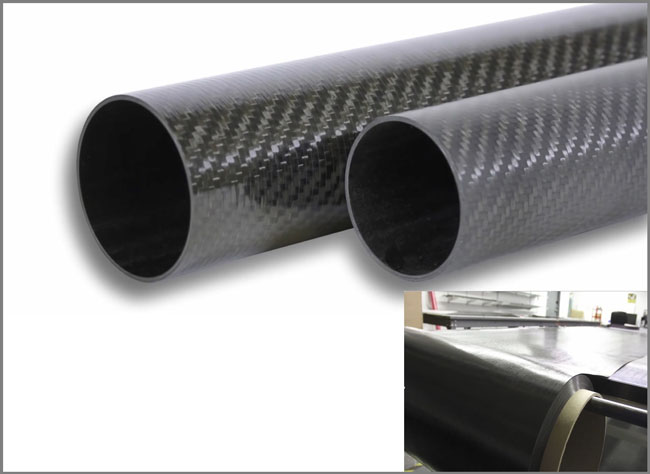
- a cross-wrap,
- an extra layer in the blank structure or
- with a blended fabric (e.g. 50 % each Kevlar and carbon).
- For example, IM fibers are often used in spinning rods, wading rods and boat rods.
- Higher-quality designs tend to be used for long rod types such as pole rods, match rods and Scrubolino models. Or also for special high-quality rods, where weight has to be saved.
3. Where does a fishing rod get its action from?
Back to the table of contents How do you give a blank the subtleties that make it a fishing rod? Well, this is done following a sophisticated plan even before the actual manufacturing process. Rod blanks are made from fiber mats (carbon, blended fabric, or other) that are cut to a specific taper shape depending on the type of rod desired. With this cut, the manufacturer determines how the later rod will behave during the- casting,
- strike and
- drill.
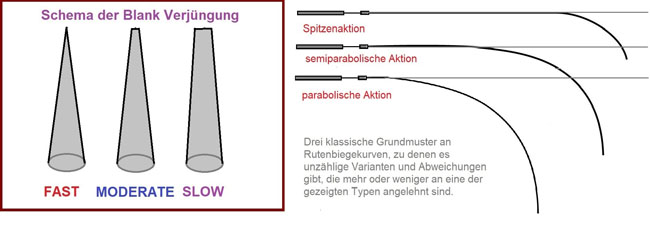
- If the blank tapers very quickly in diameter (fast taper), only the upper part bends downward when the rod is loaded (tip action).
- If the taper is slower (moderate taper = semi-parabolic action), the result is a moderate tip action. I.e. the bending curve goes at most up to half of the rod length.
- If the taper is barely noticeable (slow taper = parabolic action), the bending curve reaches until the handpiece area.
So what does the action mean in fishing rods: The rod action determines how quickly or slowly actions are implemented by the rod. That is, how much it bends under load and straightens again when the load is removed.
Between the described tapering options, there exist a whole range of intermediate solutions. Among them are also those that do not necessarily fit into the scheme described, such as the progressive action. Why the bending behavior of the blank is important for the rod selection - and why fast (taper) and slow (taper) have a meaning for the angler - we will take a closer look at in the following section.3.1 Which rod action do I need?
Back to the table of contents As mentioned above, the bending behavior (action) is already defined in the manufacturing process. Always taking into account the desired effects on the usage behavior.- Rods with a tip action bend more or less only in the area around the tip. These can be cast particularly accurately because the casting energy is concentrated only on this rather small area. Stippler rods from 3 m upwards are typical representatives of this type. So are modern rods for jigging or vertical fishing, where the lure is directed only with the tip, so that the attack must be fast and with short distances.
- Rods that have a medium bending action up to 50% of the rod length cover a range from moderate tip action to moderate parabolic action. They are suitable for practically all types of fishing and fishing techniques and therefore represent the bulk of the rod range. Compared to the pure tip action, they are less precise in casting, but achieve a better charge - and thus greater casting distances - due to the larger bending range. When playing a fish, their bending action can help cushion its lunges and runs.
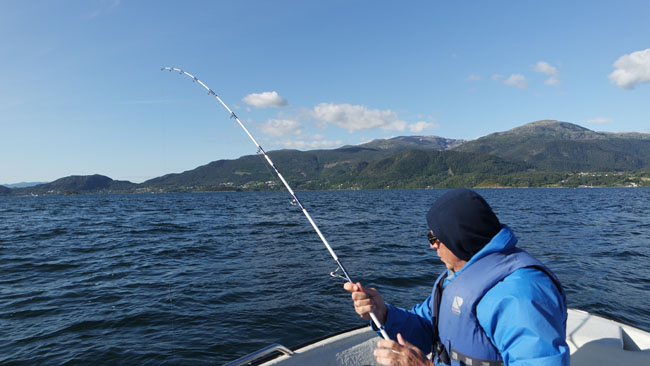
- Rods with parabolic or continuous action need a little more time to build up energy and release it over the entire length. However, they develop a lot of power during casting - a significant advantage when long casting distances are desired. Their bending action also helps cushion the load when playing a fish. With these rods, exact placement of the lure is less possible. If it should come down to this, one would rather choose a medium bending curve. Typical representatives for this action type are soft carp rods or those for surf fishing.
- at low load only in the tip part,
- at medium load it bends up to the half of the rod and
- only with extreme demand up to the hand part.
Progressive action means nothing else than a progressive bending curve under load.
3.2 What is a fast fishing rod?
Back to the table of contents There are a number of misunderstandings on this subject. Especially because the English terms such as fast (taper) and slow (taper) are often misused. With these, however, only a fast or slow taper of the blank is generally meant. Of course, a rod with a tapered action will return to its "straight" starting position more quickly than one whose action extends along the entire length of the rod because of the short travel distance (fast taper). In this respect, the use of the terms fast and slow on the one hand is not entirely wrong when talking about a fast rod action.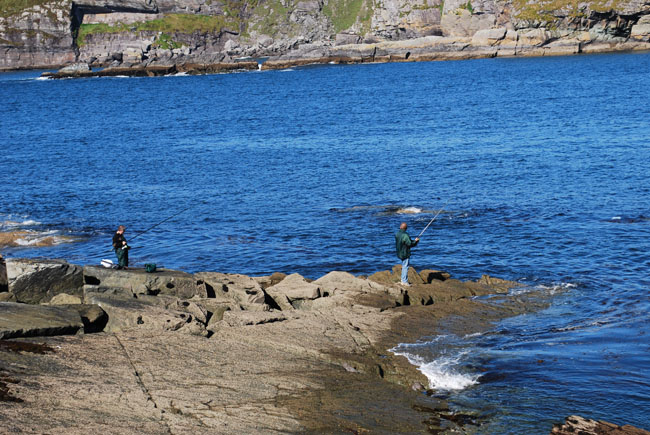
- slow rods have a small attenuation factor,
- fast ones a large one.
4. What does the casting weight (CW) of a fishing rod mean?
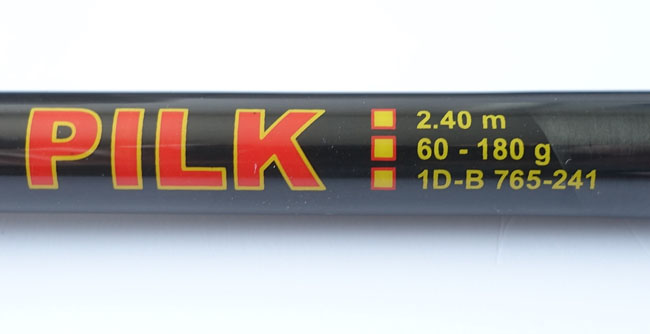
Back to the table of contents The casting weight specification of a rod is another important differentiating feature, in addition to the action curve and recovery behavior. Basically, the casting weight (CW) roughly divides rods with the same action and equipment details into three categories. Depending on whether I need a rod for light, medium or heavy fishing.In table form, this would look like this for freshwater fishing:
| Type of fishing | light (from - to) | medium (from - to) | heavy (from on) |
|---|---|---|---|
| Casting weight | 2-30 g | 30-80 g | >80 g |
Which is the best fishing rod?
In the following we have listed a few examples of good fishing rods (including their casting weights) for you.Example 1: Ground fishing on carp in a lake from the shore.

Example 2: Walleye rod for fishing with dead bait fish at my home water dam (also from the shore).

- a length of 2.70 - 3.30 m,
- a CW of 10-40 g,
- a moderate tip action and
- a fast, sensitive blank.
Example 3: Spinning rod for pike (also from the shore).

- For standing waters, I would prefer rods up to 2.70 m with moderate tip action or progressive action.
- For large flowing waters it may be longer, because the pike must be led sometimes in the current area and on longer distances. In addition, the stop sometimes makes a large lever necessary. Here, 3.30 m would be the upper limit.
4.1 What does the indication LBS on a fishing rod mean?
Back to the table of contents A rating in pounds needs context. Carp rods may be labelled with a test curve, whereas boat and other rods may instead specify a recommended line class. These are different ratings and neither should be confused with a stated casting-weight range. Read the manufacturer's specification for the particular rod.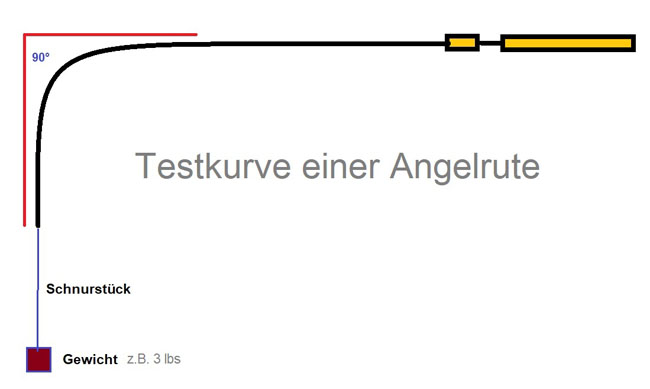
- So for a heavy carp rod with a test curve of 3.5 lbs, it would take 3.5 x 453.6 g = 1587.6 g (1.6 kg) to reach this condition.
- Do not interpret a 30 lb line-class rating on a boat rod as an instruction to hang a 13.6 kg test weight from its tip.
A test curve alone does not establish a precise optimum casting weight. Use the manufacturer's casting guidance for the specific rod rather than treating a conversion formula as a safe limit.
4.2 The weight specifications in fly fishing
Back to the table of contents Fly rods, in turn, follow the AFTMA standard classification for fly lines. Since fly fishing involves casting with the weight of the line, line weight and rod type must be matching. The AFTMA class indicates the weight of the first 10 yards (9.14 m) of the fly line. For a Class 4 line (light trout and grayling fishing), the first 10 yards weigh 7.8 grams. For two-handed salmon fishing with class 9, it are already 15.6 g.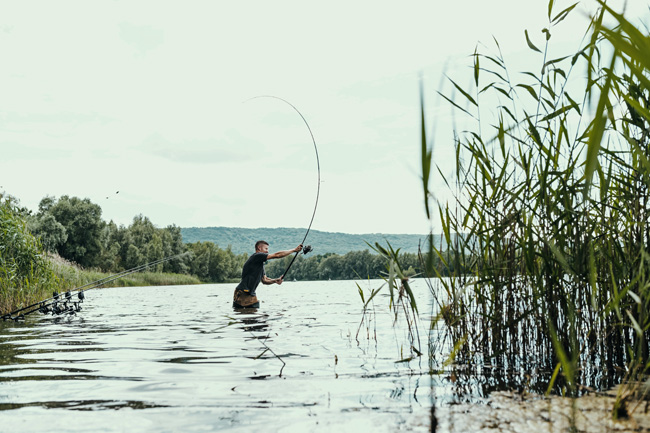
5. What is there to consider in terms of equipment?
Back to the table of contents We have already discussed the most important characteristics for the selection of a good fishing rod, such as the properties of the blank. But there is a lot more in terms of equipment that you should consider when making your purchase decision. Rod grips and reel seats are just as much a part of this as the barrel rings, their winding and the varnish.5.1 Handle and reel seat
When it comes to rod grips, opinions differ as to whether it always has to be cork - or whether an EVA grip (similar to neoprene) is the better solution. We personally prefer to work with cork grips, not only for the sake of quality.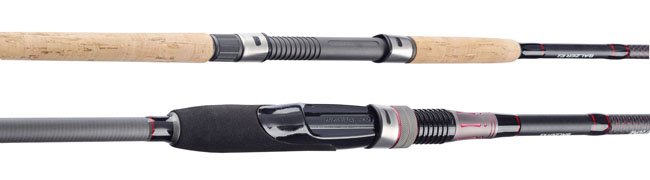
5.2 Rod guide rings
Back to the table of contents Among the most important equipment details for us are the rod guides. Here, one can't be sophisticated enough. In other words, every additional euro you spend on quality barrel rings is money well spent. Tungsten carbide designs without inserts are no longer part of the inventory, even for inexpensive rods. When it comes to line guides, you may basically demand rings with a hard insert such as Hardloy or, better, SIC or carbide, which can also handle braided lines without causing corrugation. Unfortunately, the specification "SIC rings" alone reveals nothing about the quality of the product. Experience shows that there exist great differences in serviceability. Bent tip rings due to insufficiently stable bars are just as much a part of this as inserts that have fallen out, cracked and broken - or even rust on the stainless steel frame, which should actually be rustproof.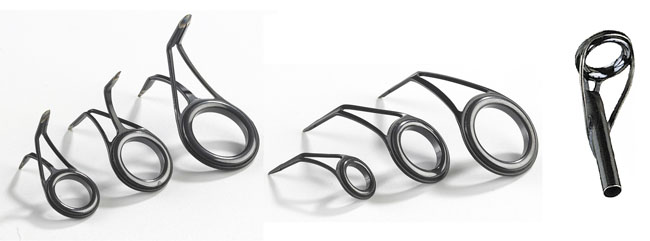
- Single footed guides belong on light flexible rods.
- Sturdy guides with two foots fit rods for heavy fishing.
- Widely spaced spinning guides are ideal for fine lines and match rods.
- Those who go for the really big fish in saltwater won't do so without rod guides, at least in the tip area.
5.3 Ring bindings and varnishing
Back to the table of contents The color design of the rod guide binding is a matter of taste. It is more important that the rings are neatly wound and do not wobble in any direction. To protect the blank, especially under load, it also makes sense to underwind the rings.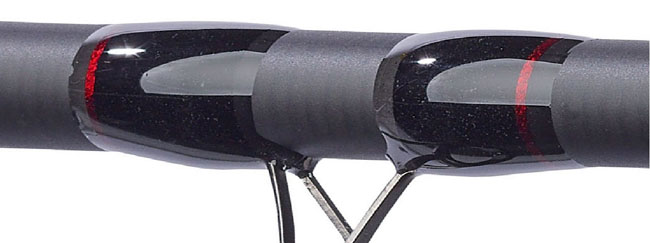
6. How much does a decent fishing pole cost?
Back to the table of contents Carbon fiber is generally more expensive than glass, while Kevlar and especially titanium are more expensive than carbon. If the blank is mass-produced in large quantities, the price difference in the starting material plays a role. Especially if high-quality carbon material is used and special additional wraps (e.g.) with titanium threads are incorporated. Small blank series with high development costs or manufacturing processes with a lot of manual work also put pressure on the price calculation. The less a fishing rod mutates into a mass-produced standard model, the more it will impact your fishing budget. Of course, we all know that not every product is automatically worth the money. But a rod twice as expensive may well have its price, if it is worth it. The angler as a buyer is the measure of all things in the end. He alone determines whether the model for his preferred types of fishing and habits completely meets his expectations, no one else. And he also decides whether the quality features of the rod meet his requirements. Experience shows, however, that cheap models are often very quickly replaced by more expensive ones, because the fishing pleasure of the cheapsters (under 60 euros) is very limited. In the middle rod price classes (60 - 150 euros) you can usually already find what you are looking for. On the one hand, the selection is the largest here - and on the other hand, all the quality features of a good utility rod are already basically available in this price range. As in many other areas, the last 20% of quality in material use and workmanship are the most expensive in fishing rods. However, anyone who has ever fished with a rod from the upper price segment (from 150 euros on), will probably find himself going thorugh this segment when buying a new rod. After all, in the end quality always convinces.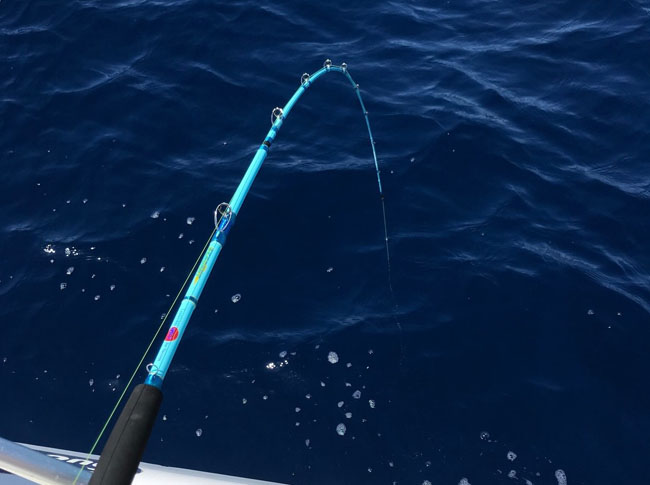
6.1 What characterizes the best fishing rods?
Back to the table of contents Rods from the upper price segment score at first glance with their flawless appearance:- With a seamless varnish,
- a design-oriented finish on the twine and
- the end caps above and below the handle.
7. What types of fishing rods do exist?
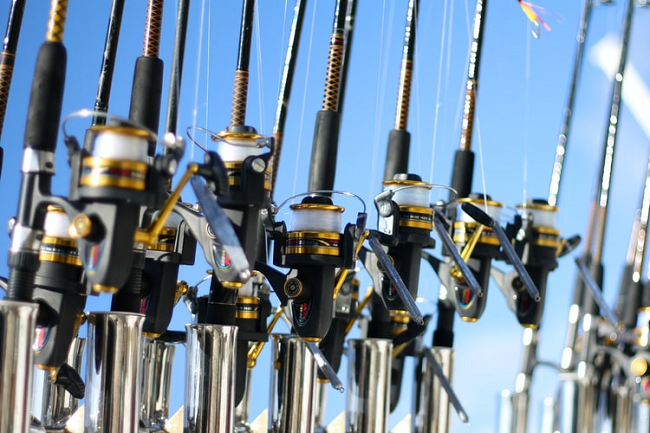
- the most important types of rods,
- their characteristic features, as well as
- their advantages and disadvantages.
7.1 Plug-in rods
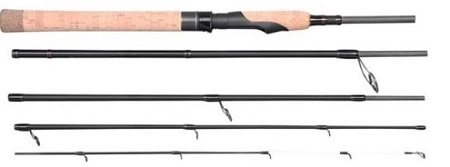
Back to the table of contents In a plug-in rod, the individual segments (each with a length of 80 - 200 cm) are plugged together to form a complete fishing rod. This reduces the transport and storage length to the segment length. In a plug-in rod, as already mentioned, the individual segments are relatively long, which means that the action and load capacity (including the number of line rings) are usually better than in a telescopic rod.7.2 Telescopic rods
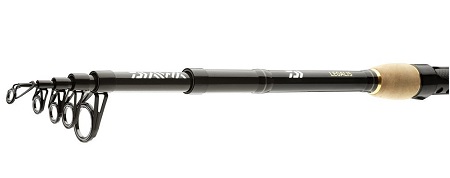
With a telescopic fishing rod, the individual segments (50 - 100 cm) can be pushed into each other to reduce the overall length to the transport and storage length. The action and load capacity of a telescopic rod is usually not as good as that of a plug-in rod. Not only, but also because the number of line rod guides is limited to the number of segments. It was invented by the American fly fishing expert Charles Ritz.7.3 Spinning rods
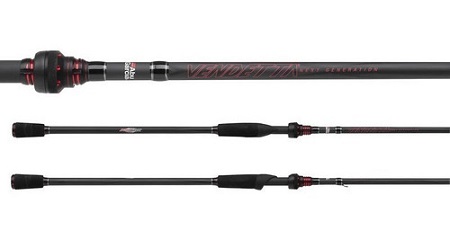
Back to the table of contents Spinning rods are the most common type of rod, which consequently can be found in the hands of anglers of all experience levels. A spinning reel is attached to the underside of the rod, making it a very versatile rod and reel combination. Spinning rods allow their users to hold them with the main hand for more stability and power. The reel is at the bottom of the rod as you cast and retrieve. The operation is relatively simple: it is only important that it is not too heavy, because you constantly hold it in your hand and have to move it a lot. In addition, you should pay more attention to the quality of the rings, because they are heavily used. Otherwise, poor workmanship can quickly lead to failure of the rings or damage to the line. Spinning rods are available in all sizes, making them suitable for almost any fishing situation. A distinction is made between ultra-light and extra-heavy models - including all intermediate levels. However, this designation does not refer to the weight of the rod itself, but to its casting weight. The gradations are:- Ultralight spinning rods with 0.5 - 12 g casting weight. Suitable, for example, for fishing for perch and trout.
- Lightweight spinning rods with 5 - 25 g casting weight. Also suitable for trout and perch, and partly for fishing for pike.
- Medium weight spinning rods with 30 - 80 g casting weight. Suitable for large trout and pike
- Heavy spinning rods with 90 - 200 g casting weight. Suitable for pike.
- Extra heavy spinning rods with 200 g + casting weight. Suitable for catfish.
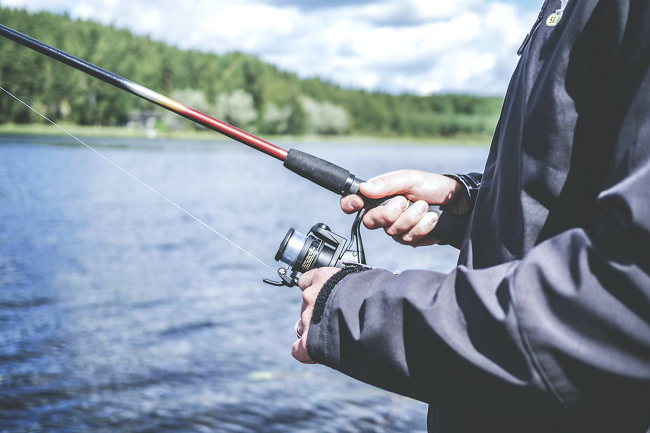
7.4 Pole rod
Back to the table of contents A pole rod is a particularly long fishing rod without a reel. An equally long leader with float, lead and hook is then attached to it. The line is usually just as long as the rod itself - a shorter line can also be used with plug-in rod variants. Fishing is usually done with natural bait for whitefish. The exception to this is tip fishing with an artificial fly. Thus, this type of rod corresponds most closely to the classic worm-rod cliché. There are two types of pole rods:- The ringed pole rod in the strict sense.
- The unringed head rod - which in turn is available as a telescopic (up to 10 m in length) and as a plug variant (up to 16 m).
7.4.1 What is a Bolognese rod?
A Bolognese rod is a special type of pole rod with highly protruding rope guides and a reel seat for a stationary reel. The length of such a rod is five to eight meters. This type of rod is mostly used for fishing at a distance (from the shore) in wide flowing waters. It allows not only a very controlled, active float guidance - in addition, the reel brake can be used to react directly to escapes.7.5 Float rods
Back to the table of contents A float rod, as the name suggests, is used for fishing with a float. Recommendable for float fishing is, for example, a match rod with a length of 3 to 4.5 m equipped with a stationary reel.7.6 Bottom fishing rods
Bottom rods - as the name suggests - are used to offer the bait at the bottom of the water. In addition to the feeder or angle picker rods designed specifically for this type of fishing, essentially all simple rod types are suitable for this purpose. In other words, all rods that are not designed for a special type of fishing, which is contrary to bottom fishing. A ground rod is suitable for use with a ground lead or feed basket.7.7 Jigging Rods
Jigging rods are used for jigging: Fishing with a jig. Such a one usually consists of a lead sinker with a hook worked into it and covered by a body made of a soft material (rubber, etc.) to imitate a prey fish. Jigs are designed to produce a jerky, vertical motion, just above the bottom - unlike spinners, which move horizontally through the water. The bounce can be created either by raising and lowering the rod, or by retrieving the line with the reel. Jigging rods are very versatile, working in both saltwater and freshwater, as well as for a variety of fish species. Ideally, they are between 2.5 and 3 m long and have a hard backbone as well as a tip action, so that the jig (such as a particularly tempting pike lure) can be handled optimally.7.8 Match rods
Back to the table of contents The match rod takes its name from the word "match" - in this case meaning "competition". The name therefore already gives an indication of its origin and original purpose: Great Britain and competition fishing - usually for whitefish. A match fishing rod is primarily designed for float fishing. Although it is possible to land big fish, the goal in match fishing is "small and lots". With a fast action combined with a low casting weight of 10 - 30 g, the angler can cover long distances with his float. This ensures versatility and the ability to fish a wider range. A faster action allows the angler to react more quickly to even the smallest bites. This is important to ensure that every dip of the float results in a catch. Match rods therefore usually have an action that is more focused on the tip of the rod. Say it bends only in the upper third. The goal here is to get the line out of the water quickly, which is especially necessary for smaller, faster fish. The length of a match rod is usually between 3.5 and 4.5 meters. Along its entire length are a large number of rings attached, which makes it possible to use very thin lines. Thus, a match rod is characterized by the following three features:- Relatively long length,
- tip action and
- dense ringing.
7.9 Boat rods
Back to the table of contents Boat rods can be spinning rods or casting rods, but they are almost always rather short and stiff. They are mainly used for trolling and vertical fishing. Whether in freshwater or saltwater, the target fish species is diverse and from large to small everything is there. Popular target fish for fishing from the boat are:- capital zander,
- big pike,
- catfish,
- perch,
- whitefish,
- salmonids like char, salmon,
- cods,
- cod,
- and, and, and...
- from 2 to 2.4 m long,
- consists of a mixture of carbon and glass fibers and
- has a medium to fast action.
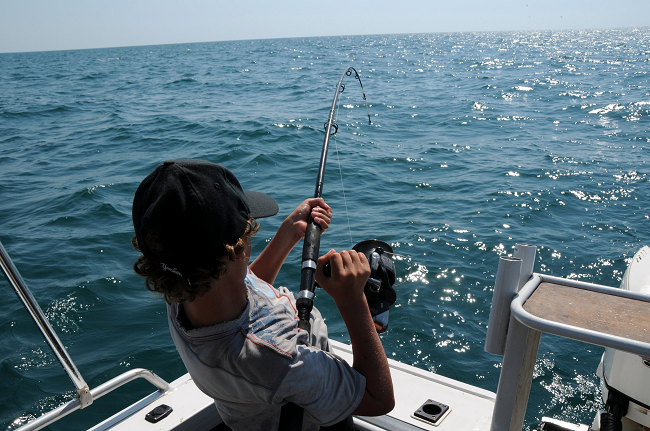
7.9.1 Pilk rod
A special form of boat rods are the pilk rods. With one of these, a paternoster or the eponymous pilker (a heavy type of flasher) is lowered vertically into the water. Depending on the target fish even until completely down to the ground. Once a fish is hooked, it is hoisted aboard by lifting the rod and reeling in the line. To withstand the heavy loads involved, a pilk rod should have a stiff backbone and measure between 1.6 and 1.9 meters. Rods with a length of 2.1 to 2.4 m are much more unwieldy because they are more top-heavy. In addition, at this length, the law of leverage already has a disadvantageous effect.7.10 Feeder rods
Back to the table of contents Feeder fishing rods range from about 2.5 (commonly called "picker rod") to 3.5 m in length. Feeder rods are equipped with a bait without float used for bottom fishing. The upper part of the rod is called the quiver tip, which is available in different sizes (thicknesses). Which tip is used depends on the size of the fish being fished for. The type of water can also influence the choice of the quivertip. If you are fishing for big fish like carp, a heavy feeder rod is required.7.11 Baitcasting rods
A baitcasting rod (or casting rod), is a fishing rod optimized for casting line and bait with a baitcasting reel. The advantages of a baitcaster essentially come from the reel. Not only is the casting distance drastically increased, but also the control over the line and hook - increasing accuracy while casting. The benefits further range from different casting techniques to increasing the size of the fish caught. Switching from a spinning reel to a casting reel can therefore be worth considering - but you should also be aware of the possible negative consequences. One of these can be irreversible tangling of the fishing line ("birds nest"). Here you have to work with different brake settings. Beginners start with a stronger brake setting and only when they are confident in targeted casting and the line rarely gets tangled, the brake can be loosened bit by bit. In the end, the pro will be pleased with incredible casting distances.7.12 Fly rods
Back to the table of contents A fly rod is a fishing rod designed specifically for fly fishing. Such a rod is usually very light and thin compared to other rods. In addition, the rings are often very small and close to the blank (the rod itself). The reel seat is located at the bottom of the rod - below the handle when the rod is held upright. The reel is mounted in this location to better maintain balance in the rod. It is also not used to retrieve line like a baitcast or spinning reel. Many fly fishermen pull the line off the reel as soon as they start fishing. And don't spool it back onto the reel until they are done for the day.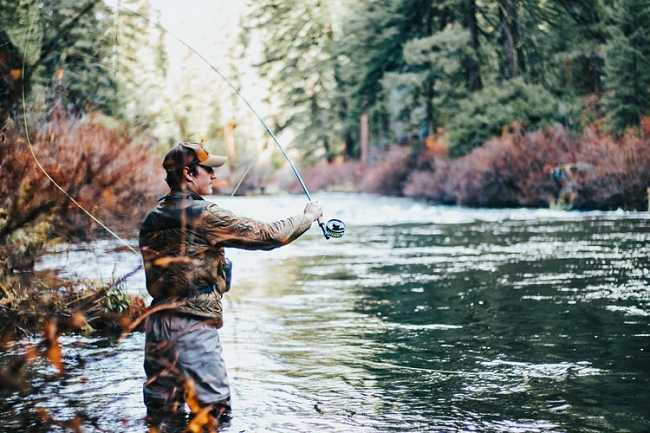
7.13 Sbirolino rods (Bombarda)
Back to the table of contents Sbirolinos are mainly (but not only) used for trout fishing. They combine a certain casting weight and float, which in its country of origin (Italy) is called Bombarda. With such a rod it is possible to cast even lightweight baits really far. Long fishing rods between 3.5 and over 4 m are used as sbirolino rods. Thus, not only long leaders can be fished, the hook is also brought through long distances. The long length in combination with a parabolic action also has a positive effect on the casting distance. The casting weight is usually between 10 and 50 g - and is essentially dependent on the size of the fished water. The fine rod tip ensures optimal bite indication.7.14 Surf rods
Surf rods are designed to be used for fishing from shore in saltwater or brackish water on coastal beaches and bays. They are long (up to 4.5 m) to allow the angler to make long casts beyond the waves into the surf. Surf rods are also equipped with a reel that can hold hundreds of feet of coarse fishing line. We recommend a rod length of 2.5 to 3 meters, with a 6000- to 8000-weight reel and braided fishing line of 11 to 22 kg.7.15 Ice rods
Back to the table of contents Ice fishing rods offer all the features of open-water rods, but in shorter versions for anglers fishing in ice lodges - rather than from motorboats or fishing kayaks. The harsh elements of hard-water fishing require strong, often heavy gear. The fish, on the other hand, with their reduced metabolism, require light, sensitive rods to indicate even the lightest bites. Many ice rods are therefore equipped with super-sensitive, ultra-thin tips. They also often feature a stiff backbone to withstand the drill when a big fish is hooked. There are ice rods as short as 0.5 meters for tight spaces in an ice shack, and as long as 1.5 meters for hole-hopping. Rod strengths range from super light rods for smaller fish to extra heavy rods for pike and lake trout.8. Which are the best fishing rod brands?
Back to the table of contents With a few exceptions for individual brands, the manufacture and sale of fishing tackle has long since ceased to be in the hands of the original manufacturer. Therefore, when we talk about a certain brand, we usually mean an international group such as- Pure Fishing (USA),
- Svendsen Sport (Denmark) or
- Globeride (Japan)
8.1 What is the best brand of fishing rods?
Back to the table of contents When it comes to the question of the best of all rod manufacturers or suppliers, there is neither a clear nor satisfactory answer. If you do not have to look at the price, you will be satisfied with Sportex, Shimano or Daiwa. The non-plus-ultra of a desired rod is of course always an individual decision and can therefore not be answered in a general way.A good and high quality rod from the middle price range up to about 120 € can be bought for different types of fishing from all the suppliers listed here.
From our combined 60 years of freshwater and saltwater fishing experience, we have identified which rods from which manufacturers were preferred over the years. WFT, Sportex, Shimano, Penn, Cormoran, Daiwa and Balzer were named again and again - with emphasis on- WFT,
- Cormoran and
- Penn.
9. Which fishing rod for which fish?
Back to the table of contents In the following table, which Jan Pusch has created for the Blinker, you will find an overview of which rod type is suitable for which fish.| Fishing rod name | Length in meters | Casting weigt in grams | Area of use and target fish |
|---|---|---|---|
| Boat rods light | 1.80 – 2.40 | 20 – 100 | predatory fish, perch, pike, zander |
| Boat rods heavy | 1.80 – 2.40 | 100 – 600 | sea fishing and big sea fish, catfish |
| Spinning rods light | 2.10 – 2.70 | 10 – 30 | perch, trout, grayling, chub |
| Spinning rods medium | 2.10 – 3.00 | 20 – 50 | perch, trout, garfish, asp, sea trout, cod from shore, zander |
| Spinning rods heavy | 2.40 – 3.30 | 60 – 100 | pike, zander, cod, mackerel |
| Surf rods | 3.90 – 4.50 | 150 – 250 | flatfish, cod |
| Head or tip rods unringed | 3.00 – 17.50 | 5 – 20 | whitefish |
| Carp rods | 3.60 – 3.90 | 60 – 120 | carp, tench |
| Feather rods, feeder basket | 3.60 – 3.90 | 60 – 180 | carp, bream, tench |
| Match rods, float rod | 3.45 – 4.20 | 5 – 30 | whitefish, bream, roach, magpie |
| Pilk rods light | 2.10 – 3.60 | 40 – 100 | cod |
| Pilk rods heavy | 2.10 – 3.60 | 100 – 180 | cod, coalfish, pollack, ling |
| Bottom fishing rod light | 2.70 – 3.90 | 30 – 60 | eel, bream, carp, herring |
| Bottom fishing rod heavy | 2.70 – 3.90 | 60 – 150 | eel, flatfish, zander, pike |
10. What fishing rods for beginners?
Back to the table of contents Every angler needs an initial equipment for his hobby. In the following, we would like to explain what the initial equipment can look like - and what considerations lie behind our recommendations. Based on many conversations with fellow anglers over the years, we know that the first rod purchases were often a wrong decision. In many cases, this was because the recommendations came from experienced anglers in their circle of acquaintances who didn't remember much about the needs of a beginner. My advisor, for example, was a commited ground angler, so my first rod was a 1.5 m long solid glass rod. In the end, however, it was not suitable neither for my whitefish fishing at the club pond nor for float fishing at the reservoir. So what are the fishing needs of a beginner? Well, these can be quite different, change quickly in the course of the beginner's life or even disappear completely when the hobby is abandoned. We recommend the following for the beginning of your fishing career:- Invest only a small amount of money in fishing tackle at the beginning.
- Do not buy more than two rods (plus reels).
- The fishing equipment should be designed for the widest possible range of use and do not buy equipment specifically designed for one type of fishing.
- Pay attention to comfortable and uncomplicated handling of the equipment.
- Pay attention to usability and robustness of the material.
10.1 Examples (recommendations) for a beginner fishing rod
Back to the table of contents Rod 1: Telescopic 3 m with 10 - 30 g casting weight.


| Equipment | Price |
|---|---|
| Rod: Sänger Bionic Phase 3 Tele 40 | 27.99 € |
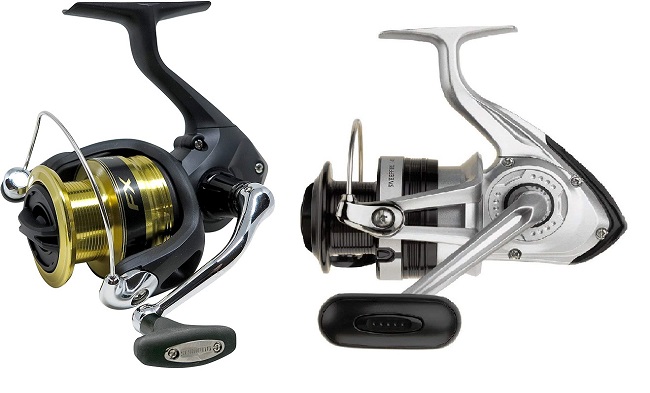
| Reel: Shimano Alivio DX Spin | 29.99 € |
| Rod: Shimano FX 2500 | 24.12 € |
| Reel: Daiwa Sweepfire 2500 | 25.93 € |
| Accessories | 90 € |
| Sum | 197.94 € |
10.2 How much does a beginner fishing rod or fishing equipment cost?
Let's now take the two cheapest rods from our proposal, these two reels and an estimate of € 90.00 for the accessories such as landing net, line, hooks, etc.. With this basic fishing equipment for beginners, you can get by with thrifty use with about 200.00 €. And that for two decent rods with two equally decent reels.11. How do you find your perfect fishing rod?
Back to the table of contents First of all, two basic decisions must be made.- First, the question of what the rod will be used for: Are you thinking of an all-around model? Or should it be a specialized model for a particular type of fish or fishing technique?
- A cost limit, secondly, will usually exist as well.
- Freshwater or saltwater?
- Light, medium or heavy fishing?
- Fishing from boat or shore?
- Transport size important?
- Plug-in rod or telescopic rod?
- Stationary reel or multi reel?

- 1 = tip action,
- 2 = moderate tip action,
- 3 = parabolic action and
- p = progressive action.

Table 1 by type of fishing rod (spinning, bottom, float and fly fishing):
| Type of fishing rod | Type of fishing | Action | Length (m) | Casting weight (g) | Bait | Fish species |
|---|---|---|---|---|---|---|
| Spinning rod | light | 1 | 1.80-2.40 | 5-20 | All types | All predatory fish, perches |
| medium | 2 | 2.00-2.70 | 20-40 | Artificial bait | Zander, tight, trout | |
| heavy | 2 | 2.70-3.00 | 40-100 | Salmon... | ||
| Pose rod | light | 1 | 3.00-6.00 | 2-15 | All types | All fish species |
| medium | 1-2 | 2.70-3.90 | 20-40 | Natural bait | ||
| heavy | 1-2 | 2.40-3.90 | 40-100 | |||
| Bottom fishing rod | light | 1-2 | 2.00-4.00 | 10-30 | Natural bait | All fish that take food from the bottom. |
| medium | 30-70 | |||||
| heavy | 2-3 | 80-120 | ||||
| Fly rod | 4-5 | 2.00-2.60 | WFTA | Artificial fly | All fish that eat insects from the water surface. | |
| 6-7 | 2.20-2.60 | |||||
| 8-9 | 2.60-3.30 |

Table 2 by target fish (whitefish, catfish, trout, carp, perch, pike, pikeperch, ...)
| Fish species | Type of rod (see table 1) | Special fishing techniques |
|---|---|---|
| Whitefisch | Pose light Bottom light | Feeder, swing tip |
| Trout | Pose light-medium Spinning light Fly 4-5 | Scrubolino |
| Perch | Pose light Spinning light | Dropshot, vertikal, jerk |
| Zander | Bottom light-medium Pose mediuml Spinning light-medium | Dropshot, vertikal, jerk |
| Pike | Pose medium-heavy Spinning medium-heavy | Dropshot, vertikal, jerk |
| Carp | Pose medium Bottom medium-heavy | |
| Tench | Pose light-medium-heavy Bottom light-medium | |
| Eel | Bottom medium | |
| Catfish | Bottom heavy Spinning heavy | Vertical fishing |
| Cod, saithe, halibut | Boad rods 20/30/50 lbs | Pilking, jigging, trolling, spoon fishing |
Table 3 by fishing techniques (feeder, jigging, vertical...).
In recent years, some fishing techniques from the Anglo-Saxon area have become very popular in our country. Fishing with feeder and quiver are special techniques of bottom fishing, where the tip of the rod acts as a bite indicator. However, these techniques have been around longer.- Jigging,
- Jerking or drop shot fishing,
- vertical fishing (near the bottom) and
- pelagic fishing (open water)
- Tip action,
- a fast blank,
- a strong backbone as well as
- the target fish of perch, zander and pike.
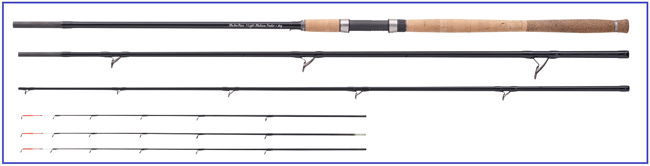
| Fishing technique | Type | Action | Length (m) | Casting weight (g) | Bait | Table 1 |
|---|---|---|---|---|---|---|
| Feeder | light | 2, p | 3.30-3.50 | Natural bait | Bottom fishing | |
| medium | 2, p | 3.50-3.90 | ||||
| heavy | 2, p | 3.90-4.20 | ||||
| Quiver | 2, 3, p | 2.40-2.90 | 10-50 | Natural bait | Bottom fishing | |
| Jigging | 1, fast, good backbone | 2.70-3.00 | 30-40 | Plastic bait | Spinning | |
| Jerkbait | 1, fast, strong backbone | 1.80-2.20 | 30-80 | Jerkbaits and wobblers without scoop | Spinning | |
| Drop shot fishing | 1, strong backbone | 2.00-2.30 | 10-25 | Plastic bait | Spinning | |
| Vertikal | 1, stiff tip | 1.80-2.10 | 10-50 | Artificial bait | Spinning | |
| Pelagic | 1 | 1.80-2.20 | 20-60 | Artificial bait | Spinning |