
DEEPER COMPARISON · BUYING DECISION
Deeper CHIRP or PRO+: Which Technology Really Helps You on the Water?
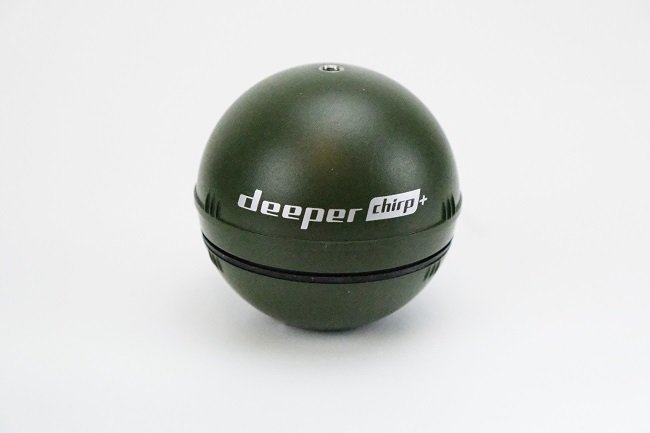
The old question “Is CHIRP worth it compared to PRO Plus?” was valid because it looks beyond the technical terminology. A fish finder is not good just because its frequency sounds modern. It is good if its display lets you see more quickly whether a drop-off is really there, how steeply it descends, and whether the area suits your target species and the season.
How does CHIRP change the Deeper sonar display?
The original course excerpt explained the ping: The device transmits sound, receives the echo, and uses it to build an image step by step. CHIRP analyzes a range of frequencies. In practical terms, this can make it easier to distinguish the bottom, vegetation, baitfish schools, and individual echoes. It can make a difference especially around steep drop-offs, small plateaus, or closely spaced signals.
The limitation is the same as with any sonar: The device sees only what lies within the cone. If you retrieve too quickly, cross a drop-off at an angle, or expect a millimeter-accurate map from deep water, even a better signal will not produce a perfect model of the body of water. Only the right question and a controlled scan make the technical advantage useful.
Why are sonar cones more important to your decision than the label on the device?
In shallow water, a wide cone can cover a large area. This is useful when you want to quickly determine where a plateau ends or where vegetation begins in a gravel pit lake. A narrow cone can inspect a promising zone more precisely: How wide is the drop-off? Is there really a ledge? Is there a small transition before the steep slope?
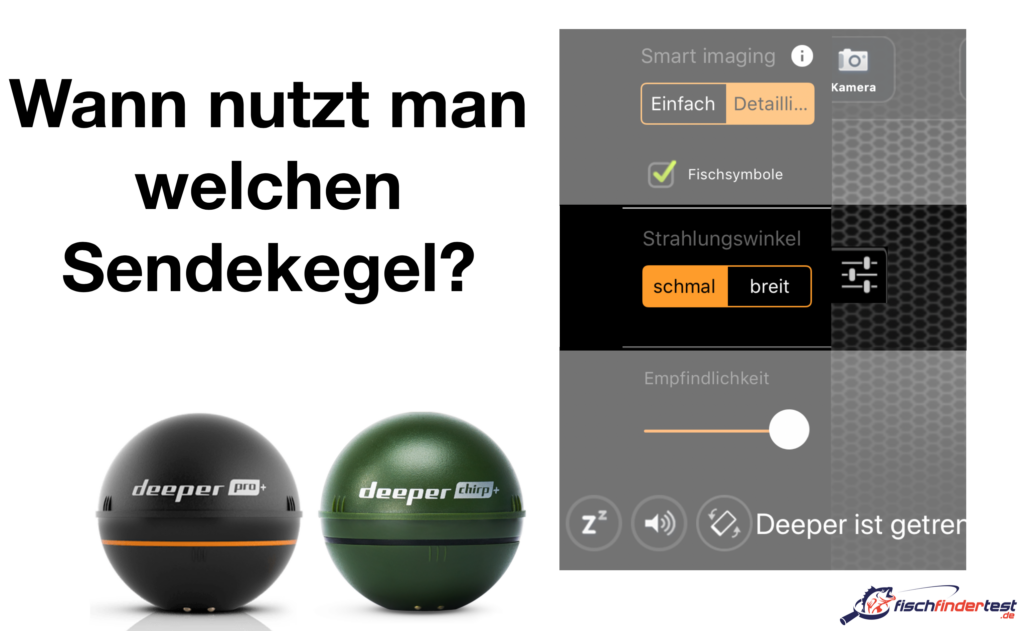
In practice, this means: search first, then inspect. Once you find a promising line with a wide cone, you can measure it more precisely with a narrower cone. Learn more in our guide to Deeper sonar cones.
When is a Deeper PRO Plus enough—and when does CHIRP really help?
| Your question on the water | What you need for it | What you should consider |
|---|---|---|
| Where do the drop-off, channel, or plateau run? | A clean map and controlled casts | GPS/mapping function, repeatability, and app support |
| Is the transition small or steep? | A detailed display and narrower view | Cone selection, retrieve speed, and target separation |
| Where is the most promising zone along a new shoreline? | Search an area quickly | Wide cone, systematic grid, and waypoints |
| Do I want the images to help me catch more fish? | Knowledge of the water and target species | The device supports your decision; it does not replace it |
For many shore anglers, mapping offers the greatest advantage: You find a transition, save it, and inspect it again during another season. By contrast, anglers who want to distinguish a few precise structures very accurately on familiar waters may benefit more from the additional target separation. There is no honest universal answer that applies to every gravel pit lake, groyne, and target species.
Which Deeper suits your target species—not just your fishing style?
When fishing for perch, closer inspection can help if you want not only to find a small plateau, drop-off, or school, but also to assess it correctly. When fishing for zander in a river, you often need the general shape first: groyne head, channel, outer edge, calm area. For pike, transitions from vegetation to open water are often more interesting than a perfect fish arch. For carp, a map and repeatable contour lines often provide more value than searching for individual echoes.
The device therefore does not need to be labeled “for zander” or “for carp.” It must reliably answer the right question about the body of water. That is exactly why, at Fischfindertest, we classify technology not as a toy but as part of a fishing plan.
How do you make an honest buying decision about a Deeper today?
- Identify the type of water: River, gravel pit lake, canal, shore, kayak, or small boat.
- Define your search question: Find an area, build a map, or inspect the details of a known structure.
- Check current devices: For a new purchase, the manufacturer's website, included equipment, and app compatibility are more authoritative than an old model review.
- Plan for practice: A good device becomes valuable only when you practice using the cone and map and interpreting the display.
The old comparison therefore intentionally remains online, but not as an automatic recommendation to buy an earlier model. Its value lies in the question behind the purchase: What information are you missing on the water—and does this device actually provide it?
This article retains the technical core of the existing CHIRP vs. PRO Plus video and reorganizes it: CHIRP, ping, sonar cones, target separation, and a buying decision based on actual value. Earlier model names are not presented as current buying recommendations.