
DEEPER TIPS · FISH ARCHES & BOTTOM
Why doesn’t the absence of a fish arch on a Deeper mean “no fish”?
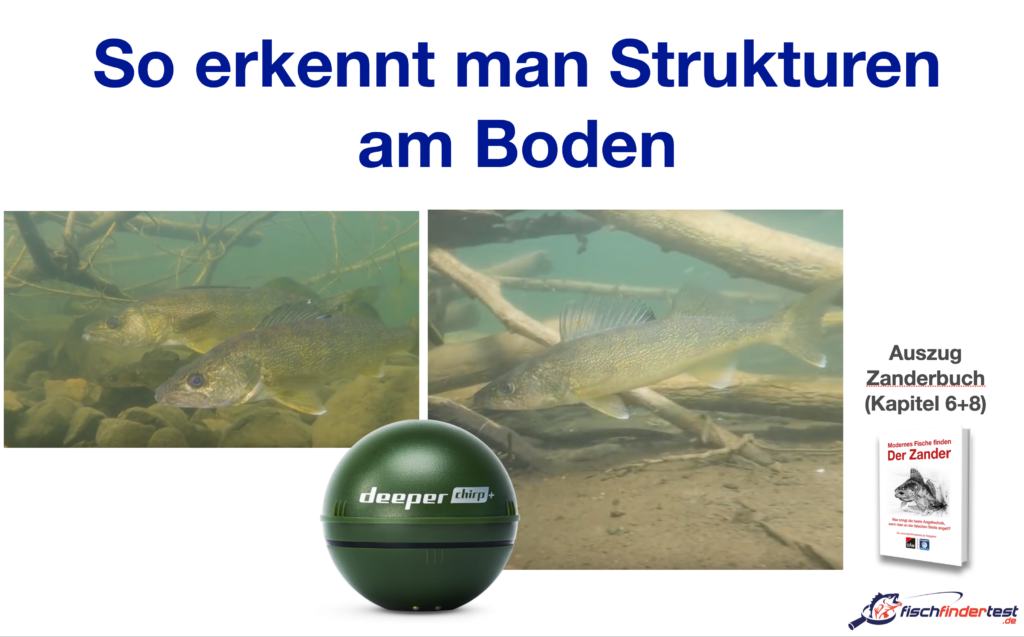
This existing URL is intentionally being retained. It answers a different, very specific question than our comprehensive guide to Deeper images and hotspots: What does it mean when you see no distinct fish arch?
How does a fish arch form on a Deeper fish finder?
A Deeper does not record the underwater world like a camera. It processes echoes. As the transducer passes a fish, the distance to the fish may first decrease and then increase again—creating an arch. If the fish is holding directly on the bottom, its echo often barely separates from the bottom line. If it is off to the side, it may be completely outside the cone. And a fish icon is an interpretation made by the app, not the fish itself.
Why is the bottom often the more useful information on a Deeper?
The previous article already made the right point: A strong bottom echo can indicate dense or hard substrate, while a change in the line can indicate a drop-off or irregularity. That is not enough to say, “Fish are definitely here.” But it is a solid starting point for the next question: Why might this area provide food, cover, oxygen, or a travel route today?
What can the difference between hard and soft bottom tell you?
In a lake, a hard area may be a mussel bed, gravel flat, or rocky structure. A soft transition may indicate mud, loose material, or vegetation. For carp, a feeding route along such a transition may be productive; for predators, the edge between two areas may serve as a hunting route. These are hypotheses—not an automatic formula for catching fish.
When does structure become a genuine hotspot?
Check a promising spot from two directions. Mark it. Then deliberately decide whether to fish above, below, or along the drop-off. For perch, prey and an edge leading to open water may be crucial. For zander in a river, the transition between current and slack water may matter more. For pike, it may be the connection between vegetation and shallow water. For carp, a route or plateau. The Deeper shows you the area; finding fish starts with interpreting it correctly.
How do you properly verify a Deeper image on the water?
- First, look for a notable change in the bottom.
- Verify it with a second cast.
- Record the depth, water level, weather, and possible prey.
- Make your first cast along the most plausible route—not blindly at an icon.
The original message and video from the previous version of this article remain: Fish arches are not everything. Clear answers, a distinction from the hotspot guide, and a practical process for applying this information on the water have now been added.